This isn't a trend, but I seem to be rather busy on Thursdays. So much so that yesterday's demo didn't happen. Perhaps I'll describe what I was up to at some later point.
Today, however, I took advantage of the light output from an iPad. Many computing devices that have an LCD type screen emit polarized light. It's why I rarely wear sunglasses when I'm out taking pictures - the polarized glasses cut out too much - sometimes all - of the light from the review screen on the back. Wearing polarized sunglasses and looking at a computer can also be tricky.
But stick the iPad behind a transparent, isotropic material and then slap a polarized filter in front of the camera and you have an instant stress-field viewer. I redid the shot of a small cap gun charge through gelatin, but this time the only light was coming from an iPad.
This turned out much better than I had hoped. First, I didn't have a lot of light to work with. Second, many computer screens will produce scan lines because the screen is "refreshing" at some frequency (it's why video of older phosphor screen monitors "flicker"). But the iPad sent out a nice steady light (I made a blank white slide in keynote and just had that as the display).
Now I think I need to get my hands on some of those old fashioned 4"x4" rock thin sections and try photographing them...
Showing posts with label high speed video. Show all posts
Showing posts with label high speed video. Show all posts
Friday, March 23, 2012


Friday, March 16, 2012
Thurs-Demo: The One There's Always Room For
So, how do you show students the effects of deformation on various materials? How do you show the accumulation of strain, or the propagation of sound waves through solid rock? You can do it in real time with some polarized filters and gelatin.
Here's a picture of our setup:

We had the bright lights up so we could get some high speed footage. That also meant the gelatin started to melt, so we were limited to about half an hour of shooting.

Here's one of the high-speed shots. I dropped a steel ball onto the gelatin. You can see the "goopy" behavior of the stuff along the top edge as well as the initial deformation followed by the surface waves radiating outward from the impact.
Now for some slicing up with a knife. I like the little "shocks" that radiate outward as I dragged the knife through the stuff.
Finally, here's another ball, dropped onto the cut gelatine. Some interesting additional wave behavior developed.
Those of you who consider yourselves "strain junkies" (yes, I'm making that a term) may be wanting some more detailed information about what's going on from a mechanical perspective. I think my colleague Todd, over at Talking Physics is planning on a more detailed discussion of the mechanics of Jello...
Here's a picture of our setup:
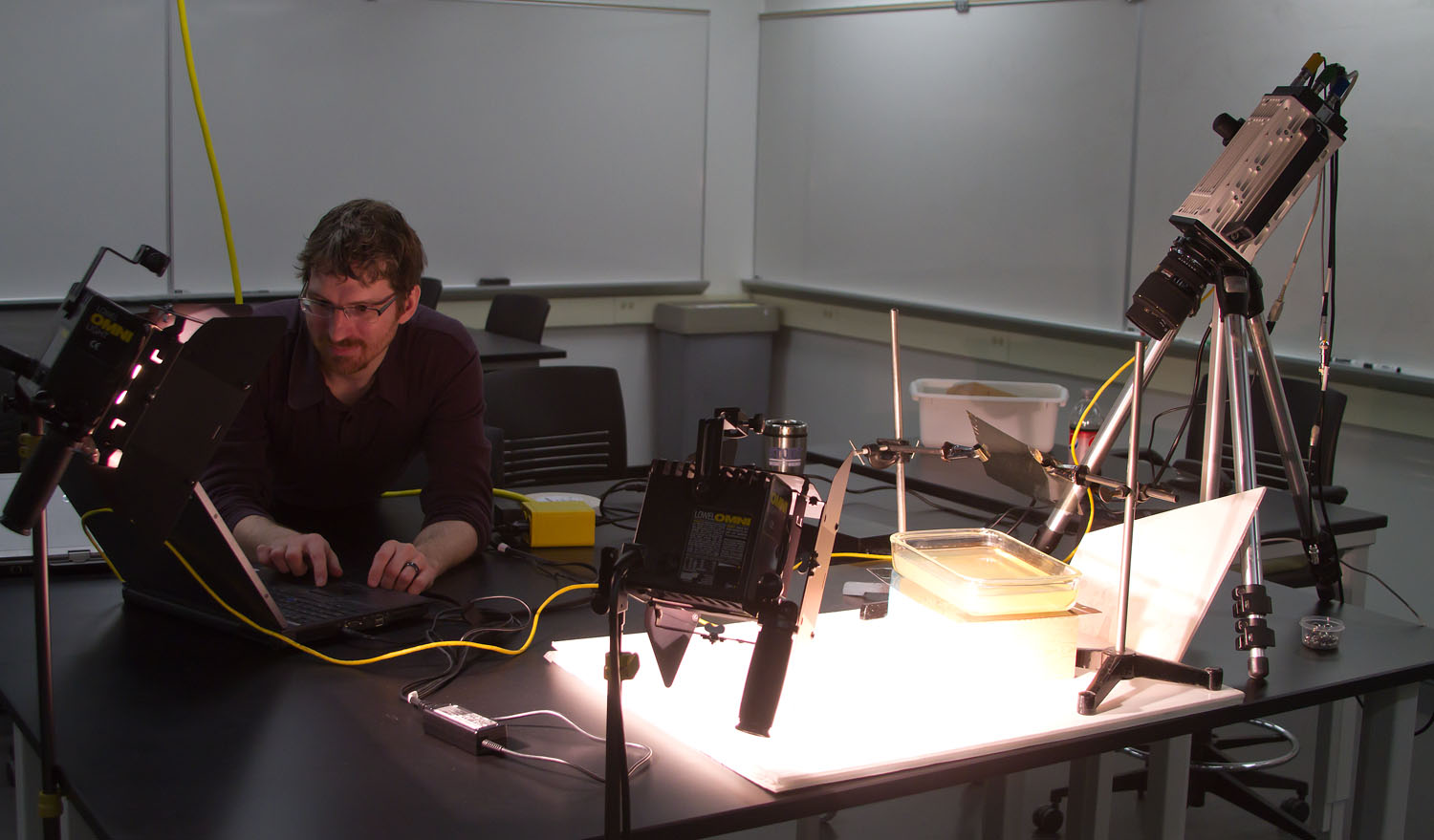
We had the bright lights up so we could get some high speed footage. That also meant the gelatin started to melt, so we were limited to about half an hour of shooting.

Here's one of the high-speed shots. I dropped a steel ball onto the gelatin. You can see the "goopy" behavior of the stuff along the top edge as well as the initial deformation followed by the surface waves radiating outward from the impact.
Now for some slicing up with a knife. I like the little "shocks" that radiate outward as I dragged the knife through the stuff.
Finally, here's another ball, dropped onto the cut gelatine. Some interesting additional wave behavior developed.
Those of you who consider yourselves "strain junkies" (yes, I'm making that a term) may be wanting some more detailed information about what's going on from a mechanical perspective. I think my colleague Todd, over at Talking Physics is planning on a more detailed discussion of the mechanics of Jello...
Wednesday, March 14, 2012
Gelatin and High Speed Video
You may have seen something like this before - using polarized light to show how a material deforms under stress. I hadn't heard anyone using this technique on gelatin before, so I just had to try it out myself. What a lovely effect. There was som über geekery to be had when we noticed you could easily produce interference patterns. I'll be providing you some more details for tomorrow's demo, but here's a peek into what's going on in the dirt lab:
For all of you strain junkies out there: I'm thinking we are looking at longitudinal strain effects at first - these spread out to a maximum distance quickly and are then overtaken by the transverse surface waves as they radiate outward. Lockwood (Outside the Interzone) mentioned that he had disabled embedded video to reduce computer issues he was having, so here's a still from one of the experiments - this way even those without video capabilities can see what's going on.

For all of you strain junkies out there: I'm thinking we are looking at longitudinal strain effects at first - these spread out to a maximum distance quickly and are then overtaken by the transverse surface waves as they radiate outward. Lockwood (Outside the Interzone) mentioned that he had disabled embedded video to reduce computer issues he was having, so here's a still from one of the experiments - this way even those without video capabilities can see what's going on.

Monday, March 05, 2012
Suggestion-based high speed
Earlier, I had asked for some suggestions about geologic concepts that would benefit from some high speed. Ron Schott suggested rock failure modes. While I'm not equipped to really fracture rocks properly, I can show something similar by showing what "soil" does under compression. Soils, like rocks, fail by "shearing" - even though a compressive force is applied to the plug of soil, it fails and squishes while pieces slip past each other.
On the subject of rock mechanical analogs, the snow on the student center roof has developed some lovely overturned and sheared folds:


Rock behaves differently on the continental scale than it does when we hold them in our hands. Hold a rock in your hand, smack it with a hammer and it will probably break into many pieces (brittle deformation). But pile a few more kilometers of rock on top, push on it slowly through tectonics so that the stress is applied over a large area, and watch the rock twist and bend wildly before finally breaking.
On the subject of rock mechanical analogs, the snow on the student center roof has developed some lovely overturned and sheared folds:
Rock behaves differently on the continental scale than it does when we hold them in our hands. Hold a rock in your hand, smack it with a hammer and it will probably break into many pieces (brittle deformation). But pile a few more kilometers of rock on top, push on it slowly through tectonics so that the stress is applied over a large area, and watch the rock twist and bend wildly before finally breaking.
Wednesday, February 22, 2012
An unexpected result
Popping water balloons is fun. But when I set up a water balloon to pop when it hit the top of an upward trajectory, I didn't expect the result I ended up with.
I really have no idea if I could replicate that or not. But you know I'm gonna try. I also tried a setup with the water balloon swinging from the side.
I really have no idea if I could replicate that or not. But you know I'm gonna try. I also tried a setup with the water balloon swinging from the side.
Thursday, February 16, 2012
Thurs-Demo:The One that Glitters
I've been thinking of a pop culture reference for today's post. I was mulling the thought of using a Tolkien-Aragorn reference, or perhaps a Twilight-Vampire comment. Instead, I'll just let you know that pearlescent paint/ink has some great potential for demonstrating fluid dynamics.

Mix a water-based pearlescent paint (this one is probably made with powdered aluminum) with water and stir. Watch lovely Von-Karmen vortices whirl about. See the transition from laminar to turbulent flow. All this can be yours for a few bucks worth of paint.
Or, if you're so inclined, mix a very thin suspension in water and then use the glittery parts to help track where the water goes.

Mix a water-based pearlescent paint (this one is probably made with powdered aluminum) with water and stir. Watch lovely Von-Karmen vortices whirl about. See the transition from laminar to turbulent flow. All this can be yours for a few bucks worth of paint.
Or, if you're so inclined, mix a very thin suspension in water and then use the glittery parts to help track where the water goes.
Tuesday, February 07, 2012
This was pretty cool: candle burning "Underwater"
I was experimenting with dropping steel balls into water. Some of them coated with hydrophobic stuff, including soot and nose oil. No, that's not a fancy brand name, it just what it sounds like. But after the fun of balls hitting water, I thought it would be interesting to drop a candle into water. I was hoping that the cavity formed by the hydrophobic material hitting the water would allow for the flame to continue burning when the candle went below the surface of the water. I managed to get it just about perfect on the first try.
Not a bad end to the day.
Not a bad end to the day.
Saturday, February 04, 2012
Not all LEDs are created equal
As many of you are aware, I've been shooting quite a few high speed videos lately. The one real limitation I have is with light. These high speed cameras are just gobbling up light like it was going out of style. Here's an example. Take your camera - if it has manual controls, go ahead and dial in an exposure of 1/1000 sec, an f-stop of around 2.8 (although for decent depth of field, I like to get around f5.6 or more) and then try and take a picture of something indoors. For our videos, we're using a pair of 500W tungsten lights. They toss out plenty of light for speeds under 5,000 fps - but they get really, really hot. 200+°C hot. Plus, a 500W light on a 120-volt circuit draws about 4 amps of current. You don't have to add too many lights before you're really sucking up a lot of electricity (and converting way too much of that into heat instead of light).
So LEDs are a really attractive option. They don't necessarily draw as much electricity and they are much more efficient. Running much cooler. They are a bit more expensive - probably about two or three times as expensive as tungsten. There are cheaper LED light panels, but the "color" of their light isn't matched to that of tungsten or sunlight - so using them together sometimes yields weird colors in the subject. LED stands for "light emitting diode." A diode is a component of an electric circuit that only allows the electric current to travel in one direction. So for a DC (direct current) circuit, the flow of electricity is in the same direction and there's not much to see. But, the electricity that "comes out of the walls" to power our appliances, lights, and televisions is AC (alternating current). The current switches direction (alternates) 60 times a second. In once cycle, 1/60th of a second, the electricity flows in one direction, and then reverses direction again. So an LED would light up for half of that cycle, then go off, then go back on again for half of the following cycle, and so on...
Good LEDs are set up to deal with this brief interruption and remain lit. I had thought that even cheap LEDs would remain lit sufficiently to provide a source of light that doesn't flicker (at 60 times per second). Shooting at anything above 30 frames per second renders any normal AC light source useless. Imagine my dismay when I looked at some AC-powered LED lights. One was an LED "worklight" and the other was a single panel for mounting under a cabinet. (cost around $20-30).
The under-cabinet light is flickering, while the worklight remains steady. This means that finding an economic set of lights is going to take some additional research to make sure they don't flicker...
So LEDs are a really attractive option. They don't necessarily draw as much electricity and they are much more efficient. Running much cooler. They are a bit more expensive - probably about two or three times as expensive as tungsten. There are cheaper LED light panels, but the "color" of their light isn't matched to that of tungsten or sunlight - so using them together sometimes yields weird colors in the subject. LED stands for "light emitting diode." A diode is a component of an electric circuit that only allows the electric current to travel in one direction. So for a DC (direct current) circuit, the flow of electricity is in the same direction and there's not much to see. But, the electricity that "comes out of the walls" to power our appliances, lights, and televisions is AC (alternating current). The current switches direction (alternates) 60 times a second. In once cycle, 1/60th of a second, the electricity flows in one direction, and then reverses direction again. So an LED would light up for half of that cycle, then go off, then go back on again for half of the following cycle, and so on...
Good LEDs are set up to deal with this brief interruption and remain lit. I had thought that even cheap LEDs would remain lit sufficiently to provide a source of light that doesn't flicker (at 60 times per second). Shooting at anything above 30 frames per second renders any normal AC light source useless. Imagine my dismay when I looked at some AC-powered LED lights. One was an LED "worklight" and the other was a single panel for mounting under a cabinet. (cost around $20-30).
The under-cabinet light is flickering, while the worklight remains steady. This means that finding an economic set of lights is going to take some additional research to make sure they don't flicker...
Thursday, February 02, 2012
Thurs-Demo: The One with Room for Cream
Getting one drop to hit another takes some timing. The higher viscosity of the cream makes it easier to get short spacing between the drops.
Friday, January 27, 2012
Water is wet - except when...
...it hits a water-repellant surface. In this case, compare what happens to a drop of water when it hits glass:
to water hitting a fabric that has been treated with a special nano-scale coating that causes the water to bead up:
The thin, spread-out film of water that forms on glass occurs because the water droplets "wet" the surface of the glass (through adhesion). The water molecules do not "stick" to the specially treated fabric and surface tension holds the water droplet together in little spheres. This is sometimes referred to as the Lotus Effect because the micro structures of the lotus leaf also cause water to form tiny spherical droplets instead of adhering to the surface.
to water hitting a fabric that has been treated with a special nano-scale coating that causes the water to bead up:
The thin, spread-out film of water that forms on glass occurs because the water droplets "wet" the surface of the glass (through adhesion). The water molecules do not "stick" to the specially treated fabric and surface tension holds the water droplet together in little spheres. This is sometimes referred to as the Lotus Effect because the micro structures of the lotus leaf also cause water to form tiny spherical droplets instead of adhering to the surface.
Tuesday, January 24, 2012
Mineral Mashing: Galena
This one turned out pretty nicely. I shot it at 10,000 frames per second, so the resolution is a little reduced. But the tendency of galena to break into tiny cubic cleavage fragments is pretty clear. And I just love the glitter effect, too.
Saturday, January 07, 2012
One of those days
Today was the kind of day where you do lots of cool stuff and the time just seems to fly by. My colleague and pal, Todd and I were trying our hands at high speed filming of popping water balloons. Todd also blogs about his physics teaching here. It was also a little strange in that my computer (a MacBook) spent most of the day booted in Windows 7, because that's what the video processing software for the camera uses. I also don't have as many internet thingies set up with my Windows partition, so I was intermittently aware of what was going on in the interwebs while I was filming.
Here was the general setup:

And here's the finished project (I tossed in some "pop" music for good measure):
Here was the general setup:

And here's the finished project (I tossed in some "pop" music for good measure):
Wednesday, December 28, 2011
Asplody Sand
While I've always known that getting good video footage or great photographs often requires some setup, high speed video demands another level of pre-planning. That's one of the reasons for shooting so many test clips early on - the more I know what is going to be needed for capturing high speed video, the quicker it will go in the future. So here's a bunch of "meteorites" impacting some alien planetary surface.
I think it's time to get these impactors moving at higher speeds.
I think it's time to get these impactors moving at higher speeds.
Thursday, December 22, 2011
Thurs-Demo: The one in Slow Motion
New technology is fascinating. I've spent the day setting up a new camera that just arrived. Here's a little demonstration:
Thursday, September 15, 2011
Thurs-Demo: The one with cleavage
Our department is getting a high-speed video camera. This alone is way-cool. However, while testing out some of the capabilities, it occurred to me that I might be able to use it to demonstrate how some minerals fracture along specific planes of weakness within the crystal. So, to try it out, I took a small calcite crystal and squished it with a pair of pliers.
It's not perfect - the frame rate (about 3,000 fps) isn't quite fast enough to capture subtle changes just prior to breaking, but it does show off plenty of tiny rhombohedral cleavage fragments spinning off as it breaks. This is one of those demos that is cheap to set up, but filming it requires the use of a rather expensive piece of equipment. But, oh is it pretty...
Mineral Cleavage Test from Matt Kuchta on Vimeo.
It's not perfect - the frame rate (about 3,000 fps) isn't quite fast enough to capture subtle changes just prior to breaking, but it does show off plenty of tiny rhombohedral cleavage fragments spinning off as it breaks. This is one of those demos that is cheap to set up, but filming it requires the use of a rather expensive piece of equipment. But, oh is it pretty...
Subscribe to:
Posts (Atom)