From Tony over at milkriverblog. Like Aydin at Snail's Tales, I have several obscure favorites. I'll just have list a few that are nowhere to be found on the IMDB top 250 (there's an extensive list of good obscure films tucked in between the obvious ones).
El Mariachi: Robert Rodriguez's debut. Filmed at a cost of about $9,000 where each scene was shot entirely with one take, this is a treat to watch. Unfettered by too much money, this is what a good action movie should be. A guitar-carrying mariachi singer tries to look for work in a small Mexican border town, while an identically dressed assassin (complete with identical guitar case) breezes into the same town. The mariachi and hit man unwittingly exchange guitar cases and hilarity ensues. Please watch this in the original spanish with english subtitles. Much better.
Rosencrantz and Guildenstern are dead: Tom Stoppard's heady, existentialist play turned into a movie. Watching the film after reading the play script, I was able to catch most of the subtle intellectual humor involved, but this movie still provides something new each viewing. Tim Roth and Gary Oldman are well paired as the two Shakespearian bit players, while Richard Dreyfus as "The Player" deftly spins the "life-as-art/art-as-life" motif.
The Snapper: Someone else already mentioned The Commitments, so I'll plug Roddy Doyle's second book/movie in the Barrytown Trilogy. It's funny, but not at the expense of the intelligence of the viewer, or dignity of the character. I haven't actually seen number three "The Van," yet, but it should probably go in with the other two as well.
Ghost Dog: The Way of the Samurai: Forest Whitaker as a mafia hit man (notice a theme in my meme?) who follows the Samurai code. The usual tale of betrayal and revenge are there, but the Haitian ice cream truck driver and the girl with whom he discusses literature make this more of a study of human nature than most action movies.
Himalaya - l'enfance d'un chef Beautiful cinematography, a classic story retold via the Tibetan salt caravan. Go read the outline on IMDB if you want. A beautiful movie - and having read the "Snow Leopard" by Peter Matthiesson gave me a better understanding of the Dolpo region.
Yin shi nan nu (Eat Drink Man Woman): Another good film. A master chef living in Taipei with his daughters, life happens and is filmed beautifully.
Well, that's a bunch more movies than I intended. I'm going to stop now before I waste all my time with this meme.
Tuesday, November 29, 2005


Monday, November 28, 2005
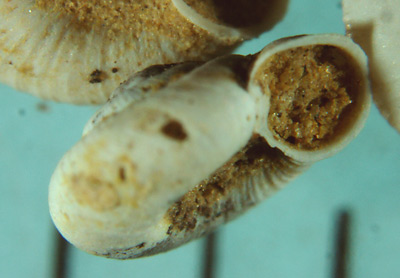
Pleistocene snails: Vallonia gracilicosta
I have tentatively identified this little charmer as Vallonia gracilicosta. A rather small snail, it is common to the Rocky Mountain regions, however, a few scattered populations exist east of the Mississippi (see map below). Scale ticks in photos are in mm.


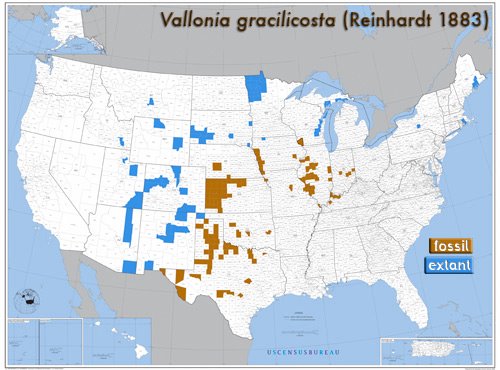
Map of the distribution of fossil (tan) and living (blue) V. gracilicosta. The range for this species shifted from the Midwest to the Rockies after the retreat of the Laurentide Ice sheet 10,000 years ago. It is also possible that previous to the Pleistocene, V. gracilicosta inhabited the Rocky Mountain region, invading the midwest during the last glacial maximum. Map is from the US Census website, while biogeographic data comes from: Pilsbry, 1939; Nekola et al., 1999; Nekola, 2002; Frest and Dickson, 1986; Hubrict, 1985; Baker et al., 1986.
BAKER, R.G.; Rhodes, R.S., II; Schwert, D.P.; Ashworth, A.C.; Frest, T.J.; Hallberg, G.R.; Janssesns, J.A.; 1986, A full-glacial biota from southeastern Iowa, USA, Journal of Quaternary Science, Vol. 1(2), pp. 91-107.
FREST, T.J. and Dickson, J.R., 1986, Land snails (Pliestocene-Recent) of the Loess Hills: A preliminary survey, Proc. Iowa Acad. Sci. 93(3), pp. 130-157.
HUBRICHT, L. 1985, The distributions of the Native Land Mollusks of the Eastern united States. Fieldiana Zool., n.s. 24, vii+191pp.
NEKOLA, J.C., M. Barthel, P. Massart, and E. North. 1999. Terrestrial gastropod inventory of igneous outcrops in Northeastern Minnesota. Final report submitted to the Natural Heritage and Nongame Research Program, Minnesota Department of Natural Resources. 60 pp.
NEKOLA, J.C. 2002. Distribution and Ecology of Terrestrial Gastropods in Northwestern Minneosta. Final Report: 2001-2002 Natural Heritage and Nongame Research Program, Minnesota Department of Natural Resources. 171+pp.


Map of the distribution of fossil (tan) and living (blue) V. gracilicosta. The range for this species shifted from the Midwest to the Rockies after the retreat of the Laurentide Ice sheet 10,000 years ago. It is also possible that previous to the Pleistocene, V. gracilicosta inhabited the Rocky Mountain region, invading the midwest during the last glacial maximum. Map is from the US Census website, while biogeographic data comes from: Pilsbry, 1939; Nekola et al., 1999; Nekola, 2002; Frest and Dickson, 1986; Hubrict, 1985; Baker et al., 1986.
BAKER, R.G.; Rhodes, R.S., II; Schwert, D.P.; Ashworth, A.C.; Frest, T.J.; Hallberg, G.R.; Janssesns, J.A.; 1986, A full-glacial biota from southeastern Iowa, USA, Journal of Quaternary Science, Vol. 1(2), pp. 91-107.
FREST, T.J. and Dickson, J.R., 1986, Land snails (Pliestocene-Recent) of the Loess Hills: A preliminary survey, Proc. Iowa Acad. Sci. 93(3), pp. 130-157.
HUBRICHT, L. 1985, The distributions of the Native Land Mollusks of the Eastern united States. Fieldiana Zool., n.s. 24, vii+191pp.
NEKOLA, J.C., M. Barthel, P. Massart, and E. North. 1999. Terrestrial gastropod inventory of igneous outcrops in Northeastern Minnesota. Final report submitted to the Natural Heritage and Nongame Research Program, Minnesota Department of Natural Resources. 60 pp.
NEKOLA, J.C. 2002. Distribution and Ecology of Terrestrial Gastropods in Northwestern Minneosta. Final Report: 2001-2002 Natural Heritage and Nongame Research Program, Minnesota Department of Natural Resources. 171+pp.
Tuesday, November 22, 2005
I and the Goose #1
The Canada Goose - what an interesting bird. Seen as a pest by many golf course groundskeepers, we have learned much about bird migration from these large fowl. I have also found them to be striking photographic subjects. Many an early fall or winter morning I would crawl a dozen meters or so through goose poop to catch them looking interesting in decent light. Two of my favorites:
From the flight photo it should be obvious that geese are powerful fliers. They aren't the fastest, or the most efficient - on their own, anyway. When they flock together in large "V's," they reduce overall drag and expend less energy as a group. But if you've ever been close to a group of them taking off, the sound is amazing. The wings beat so forcefully that the buzz of air past the primary feathers sounds just like a jet engine. Not the highly maneuverable aerobatic stunt plane (anyone who's seen a flock of geese try to land together on a small pond can tell you that), or the high altitude sailplane, but the long-range cargo transport of the avian world.

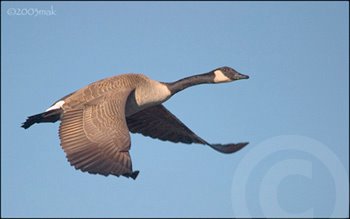
Goose in flight.
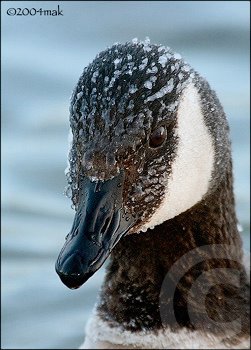
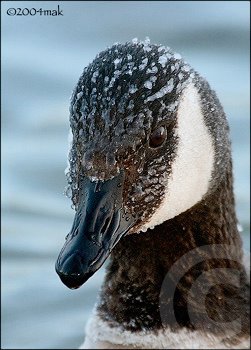
A very cold (-13°F) January morning and they still would prefer to paddle around on what open water there was.
From the flight photo it should be obvious that geese are powerful fliers. They aren't the fastest, or the most efficient - on their own, anyway. When they flock together in large "V's," they reduce overall drag and expend less energy as a group. But if you've ever been close to a group of them taking off, the sound is amazing. The wings beat so forcefully that the buzz of air past the primary feathers sounds just like a jet engine. Not the highly maneuverable aerobatic stunt plane (anyone who's seen a flock of geese try to land together on a small pond can tell you that), or the high altitude sailplane, but the long-range cargo transport of the avian world.
Wednesday, November 09, 2005
I and the Bird #10
While I tend to focus on items of the molluscan kind, I do fancy myself as a general naturalist and have a particular vertebrate fancy for birds (and all dinosaurs).
I've got an entry for I and the Bird #10 about Sharpie coloration over at Thomasburg Walks. I'll probably have to put something together for #11.
In other news, I've got more samples, including several specimens of Strobilops that I have to identify yet. I'm down at my school of learning to meet with my advisor and some other folks to try and set up another hoop in the process of my PhD (well perhaps "planning the way in which I will get through said hoop" is a better way to put it.
Andy Knoll is giving a talk tomorrow at UW Madison. I'm going to see it. Had I been planning ahead, I would have gotten in town earlier. But that's just the way things are, I guess.
I've got an entry for I and the Bird #10 about Sharpie coloration over at Thomasburg Walks. I'll probably have to put something together for #11.
In other news, I've got more samples, including several specimens of Strobilops that I have to identify yet. I'm down at my school of learning to meet with my advisor and some other folks to try and set up another hoop in the process of my PhD (well perhaps "planning the way in which I will get through said hoop" is a better way to put it.
Andy Knoll is giving a talk tomorrow at UW Madison. I'm going to see it. Had I been planning ahead, I would have gotten in town earlier. But that's just the way things are, I guess.
Monday, November 07, 2005
The identification of a snail
Here is a snail whos ID I have been working hard at confirming. The two likliest candidates are Discus shimeki, or Discus whitneyi. I am leaning towards D. shimeki, but there are just enough characters that aren't conclusive to keep things interesting. First, here are some photos (The top photo is a different individual, but from the same geographic location and deposit).


Here is a list of the characters listed for D. whitneyi, taken from the BC Museum's "Living Landscapes" website.
And here is the same for D. shimeki:
So what do I have? My snails are about the right size for either, although some of them are a wee-bit larger. Most of them are mostly rounded, some do have a sub-angular periphery. I haven't seen any axial striae between the riblets, but the riblets generally are indistinct along the base - especially on the largest specimens. The biggest reason I'm calling it D. shimeki is because of the umbilicus. The umbilicus is about 33% or less of the total diameter on all specimens. I will have to get my measuring ocular out and confirm this statistically, I bet. Lucky for me I'll be heading back to Madison and the library this week.


Here is a list of the characters listed for D. whitneyi, taken from the BC Museum's "Living Landscapes" website.
Shell small (width, 6.7 mm), depressed-heliciform; subtranslucent brown or occasionally pale coloured; spire low; whorls 4.5, convex or a little angular (especially in juveniles); suture deep; protoconch without riblets; teleoconch with nearly equally spaced axial riblets, extending onto the base, and fine axial striae; aperture rounded and without denticles; outer lip unthickened; umbilicus rather large, about 33-40% of the width of the shell.
And here is the same for D. shimeki:
Shell small (width to 6.5 mm), more or less depressed-heliciform, subtranslucent, yellowish brown; spire moderately elevated or flattened; whorls 4.5, convex; periphery rounded; protoconch smooth; teleoconch with regular, strong axial riblets with fine axial striae between; riblets rarely extending onto the base and becoming lower and irregular on the last whorl; aperture typically rounded, or more ovate in the flattened form of the species; aperture without denticles; outer lip unthickened; umbilicus rather large, about 30% of the width of the shell.
So what do I have? My snails are about the right size for either, although some of them are a wee-bit larger. Most of them are mostly rounded, some do have a sub-angular periphery. I haven't seen any axial striae between the riblets, but the riblets generally are indistinct along the base - especially on the largest specimens. The biggest reason I'm calling it D. shimeki is because of the umbilicus. The umbilicus is about 33% or less of the total diameter on all specimens. I will have to get my measuring ocular out and confirm this statistically, I bet. Lucky for me I'll be heading back to Madison and the library this week.
Friday, November 04, 2005
Some more ice age land snails

I was looking at this photo and I noticed I have what seem to be two succineids in this sample. Compare the one on the upper right to the one in the lower middle. There is a distinct difference here that I hope isn't just ontogenetic.

From top to bottom: an egg, Columella alticola, Pupilla muscorum, Vetigo cf. modesta, a succineid (Catinella sp.?), and Discus cf. shimeki

Discus cf. shimeki and one round snail egg.
Subscribe to:
Posts (Atom)