Wednesday, October 17, 2012

Hacking the Em2, Part 1

From reading this blog, you may have guessed that I like studying rivers. In particular, I really like figuring out the ways in which rivers transport and deposit sediment. Because in those sediments might be fossils! And fossils tell us about the history of life over grand time scales. Fossils are cool. So are rivers.

My lab is lucky enough to have an Em2 stream table, built by the great folks at Little River Research and Design. Their founder/president/zeroth poobah, Steve Gough blogs about rivers and things, too.


It's been just about a year since I first set up the Em2 in the lab. Straight out of the box (off the shipping pallet, really), this thing does a lot of cool stuff. But for research, I wanted to tweak some of the variables. Or, at least quantify the characteristics of the stream table itself.

I began with looking at the plastic sand itself - I don't want to go over that today, but I've made a few references to the material before. A full-blown analysis of the sand that ships with the stream table is probably worth its own series of blog posts. For now, let's look at the flow of water from the pump into the stream table itself.

In hydrogeologic terms, the amount of water flowing past a specific spot (or cross-sectional area) for a particular period of time is called discharge (often labeled as Q, and is provided as a unit-volume per unit-time). If we know the cross-sectional area of the river, pipe, or whatever and the velocity of the flow, we can calculate discharge as area x velocity. An even easier method for small systems, although this averages out any instantaneous variation, is to simply hold a container underneath the open end of the pipe. Fill the container to some volume, use a stopwatch to calculate the time it took and divide the volume by the time.

The LRRD stream tables make things even easier - the water that comes from the pump pours out into a "notch gage." This notch gage gives you an "at-a-glance" view of the discharge. The higher up the notch the water is, the greater the discharge. Easy Peasy. No moving parts, no math, just eyeballs. Except that I wanted to compare high discharge experiments (high flow rates) to low discharge ones. Or if I wanted to repeat an experiment, I wanted a way to know the flow rates were the same. Bring on the bucket method described above.


First, I made reference marks on the gage itself starting at the bottom of the container, I made marks every 0.5 cm all the way to the top, giving me a reference point along the notch. Then, I placed the gage on a platform so I could put a bucket underneath to catch the water flowing out the notch. Now, set the flow to a certain reference point on the notch, collect water for a minute (or at least 10 seconds, depending on flow) and find out the volume of water. Repeat.

Using a ruler to make reference marks every 0.5cm.

Running the test using a faucet for flow and a 2x4 platform.
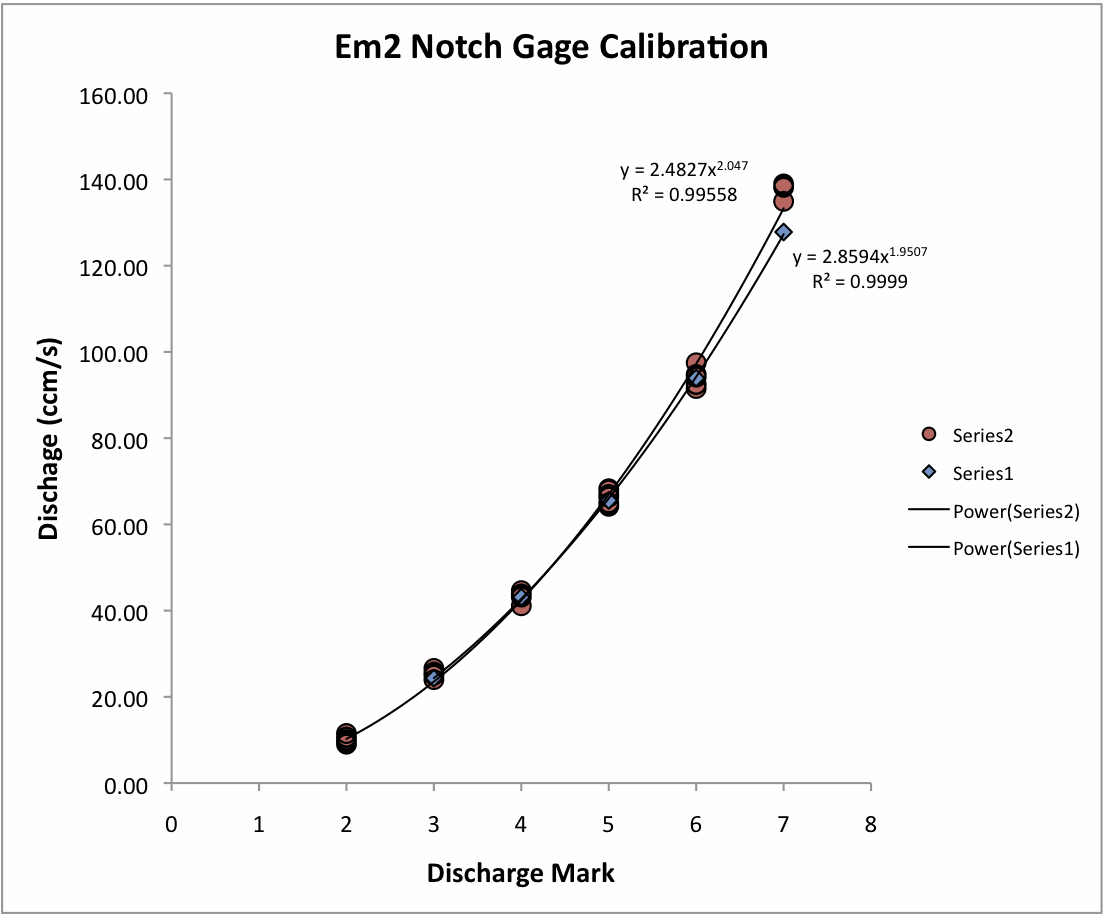
Graph of discharge versus notch mark (note: measuring flows below the 2nd mark were problematic because the surface tension of water prevented accurate water collecting)


Now I have data that tells me if I set the flow through the notch to the third mark, I know the discharge is about 24 cm3/sec. I can use it to monitor the pump and adjust things if there are changes in the hydraulic head (pump hose elevation, reservoir water level, etc.)

The best part? Anyone with the notch gage can do this too. And if the geometry of the notch gage is the same from one gage to another (presumably so) you can just make marks every 0.5 cm and go with my data. But if you're serious, you'll calibrate/confirm your own gage, right?

Go on, you know you're just itching to quantify stuff. I won't be able to attend GSA this year, so I'm hoping to give everyone a little taste of what I'm up to.

Stay tuned to see what I did to go from this...


To this - it's all about SCIENCE!


Tuesday, October 16, 2012

Managed Mischief Continues

Something a little more light-hearted this time...

My author pal Kelly McCullough and his wife have a tradition of getting all kitted up and taking their anniversary picture somewhere interesting. They've appeared in formal dress in Glacier National Park, Los Angeles, the San Diego Zoo and other places. Last year I took a nice posed portrait. This year, however, they went for action. So with the help of Neil Gaiman's trampoline, his white german shepherds Lola and Cabal.


I set up some off-camera flashes and they became, as Neil described, "The Fabulous Flying McCulloughs"


One of the things I like about my friends is they're willing to be goofy and willing to give me opportunities to scratch my photography itch.

My wife and I have our 8th anniversary today. We're going out to eat at a local Fancy Restaurant (tm). I'm looking forward to it - she gets more awesome every year.


Sunday, October 07, 2012

In Memoriam: Dr. James Knox

The world seems a little darker now. One of the giants in the world of fluvial geomorphology passed away this weekend. This evening I learned that Dr. James (Jim) Knox, professor emeritus of geography at UW-Madison died yesterday after a heart attack. I had hoped to share many exciting things when I had the chance to get back to blogging, but I really want to put these thoughts out there in memory of a wonderful teacher.

I first met Jim when I was a new PhD student on a field trip through southwestern Wisconsin on a cold, early spring weekend. I was just beginning to realize that my project involving fossil snails was going to need a good chunk devoted to rivers and how they were depositing fossil rich sediment during the last ice age and then eroding down to leave these fossils behind for me to uncover. During that field trip he had so much to share he would talk to both vans via the walkie-talkie. He spent so much time talking about the rivers and fluvial history of the area, he ended up draining the batteries in the walkie-talkie more than once.

Getting a PhD is a lot of work. Much of that work is done by the student, but - as they say - it takes a village to raise a dissertation. The advisor and committee get most of that work, but there are many more scientists involved. Jim wasn't on my committee, but he may as well have been. I wasn't a fluvial geomorphologist, but I had to become one in short order to do the work needed for my research. And so it was to Jim's office that I would go to share data and ideas related to rivers and the changes they went through. Without his generous help, my ideas about stream behavior would not have gotten me through the dissertation.

Last year, Jim retired and there was an entire session at the Geological Society of America meeting in Minneapolis dedicated to honoring his work and that of his students and colleagues. The photo below shows Jim as I will always remember him. Enthusiastic and a reservoir of immense knowledge. Someone who was always willing to stand in a sand pit, discussing the finer points of base level and sediment supply. His work related to the late Pleistocene history of the Upper Mississipi Valley changed my entire way of thinking about rivers. His work on the impact of humans on river systems continues to shape the work that I do now.


There isn't much in the way of obituary information, but more will probably appear here. His knowledge and enthusiasm will be deeply missed.

Thursday, September 27, 2012

ORLY?

Not that I don't want to get all super-excited about martian conglomerates, but Erik Klemeti via twitter (@eruptionsblog) has a good point about alternate interpretations for those rocks.
Volcaniclastics (Tertiary, Utah)


Wednesday, September 19, 2012

The day to talk like one...

Arrr, to-day is the day for keelhauling and shivering of timbers. So you may need one of these: