Sunday, January 08, 2006

The "Ouzel."

It was a few years ago that I first picked up my own copy of David Sibley's bird guide then followed his "Guide to Bird Life and Behavior." Being an artist and naturalist, I loved just looking at the birds as paintings - it was amazing how he managed to capture feather patterns with brush strokes.

One bird, in particular, grabbed my attention: the American Dipper (Cinclus americanus). Specifically, his sketch of it walking along the bottom of a cold mountain stream. It quickly became one of those bird I had to see myself. My first opportunity came the summer of 2004 during field work in Wyoming. I didn't see much of it, but there was no mistaking the bobbing, the white eyelid and the squat little charcoal body. A vacation to Rocky Mountain NP later that summer netted me a fine picture:


Back in Wyoming the following summer, a family of Dippers made the stretch of stream near our camp its home. Every day, two juveniles would beg their parent for food - watching anxiously as they would crawl along the bottom of the stream looking for food:


The American Dipper is the only bird of the Cinclidae family in North America - in Asia and Europe there are about 4 other species. They used to go by the much more poetic name of "Water Ouzel," but dipper seems to be the nom-du-jour.

Friday, December 30, 2005

Snail biogeography


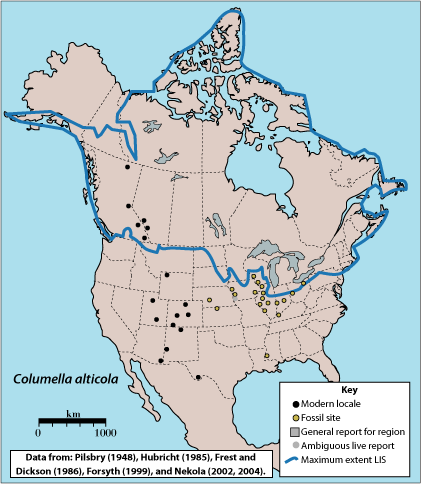
I drew the above distribution map for Columella columella alticola based on several sources (see graphic), including my own research. The open circles are Pleistocene fossils and the dark dots are modern sites where they are found. The species name indicates it's simlilarity to the European species C. alticola. So how does a snail so similar to its European cousin get across North America? Aydin at Snail's Tales discussed the distribution of another holarctic land snail. One of his suggestions for distribution on two continents was via plate tectonics. Personally, I think genetic drift would have resulted in greater phenotypic difference over the 200 million years since Europe and North America were last next door neighbors.


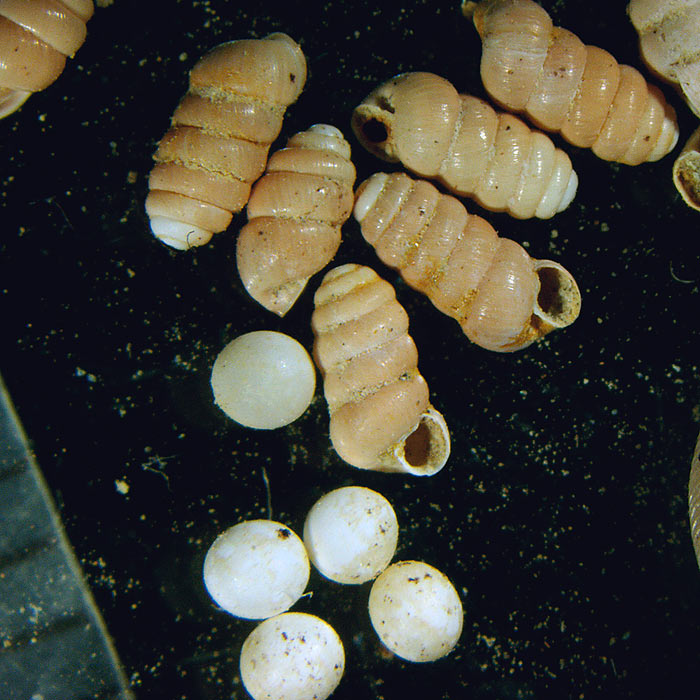
Columella columella alticola and snail eggs as Pleistocene fossils from the midwest.


If not tectonics, then what? Looking at the distribution, I wonder if many species of snail took advantage (if I may anthropomorphize a little) of the Bering land bridge. Given that there are several species that share this holarctic distribution (eg: Z. harpa, C. columella, P. muscorum). So, how do they do it? Birds, wind, large mammals? And how might one differentiate between distrubution via tectonics versus land bridges? DNA studies for one, but the other would be better time control on fossil distribution. A project too grand in scope for my own dissertation, but perhaps there are some paleontologists who have already started on this project?

Food for thought on the penultimate day of 2005...

Friday, December 09, 2005

Snail dispersal idea.

I have been wondering about snail dispersal - do they really get caught up with large mammals and birds? I'd be interested in doing a country-wide study next hunting season: taking a flea comb and looking for snails caught in the fur of deer taken during hunting season. Anyone else interested in looking for snails caught up in megafauna?

Sunday, December 04, 2005

A bird in the hand...


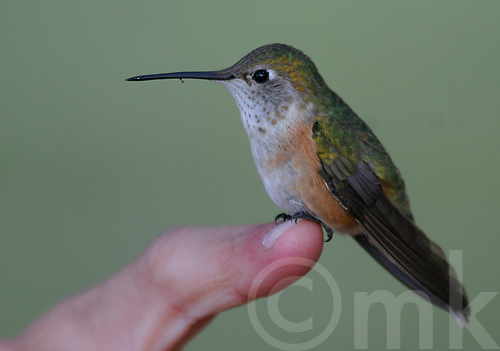
Last year my wife and I took a trip to Rocky Mountain National Park. Normally, one might go to a beautiful spot like RMNP and not take their camera out until they get within the park. But, this little campground just south of Estes Park provided me with the signature image of that trip. It's a Broad Winged Hummingbird female, waiting to get a shot at the nectar feeders set up near the camp check-in. Keep your camera handy - you never know when an image will come.