I don't think I've put this video on the blog. I got tired of just dropping one ball on gelatin - so here's a slow motion study of four balls dropping onto gelatin. I like the individual impacts and then the interference created by overlapping shockwaves:
Monday, April 30, 2012


New Favorite Thing
As much as I enjoy filming water balloons bursting in slow motion, I am always interested in trying new approaches. Perhaps one of the best is achieved by adding a little bit of gelatin to the balloon. At least, I'm a huge fan of the idea. The only drawback is that they take about four times as long to clean up.
Sunday, April 29, 2012
So, this happened:
Last weekend was somewhat epic. I got some sweet high speed video footage of a male bluebird attacking its reflection in our window (update: it's still seeing something, so I've got to upgrade my deterrent system). I love the aerodynamics inherent in this video.
I was also invited to visit a beekeeper and shoot high speed video of bees pouring into a hive.
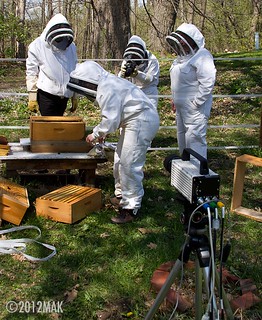
Here's the result:
It was a fantastic weekend. I really want to get some more bee footage - while my research on live snails may not lend itself to high speed video, insects certainly are. I'll leave you some additional pictures of the day:
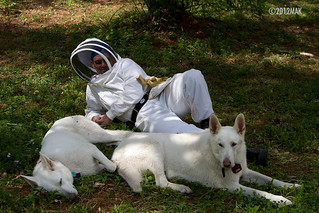

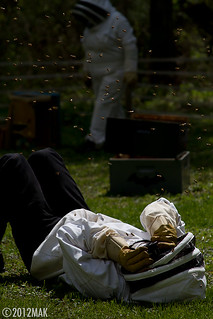
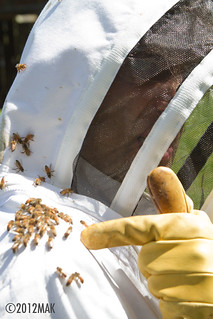
I was also invited to visit a beekeeper and shoot high speed video of bees pouring into a hive.
Here's the result:
It was a fantastic weekend. I really want to get some more bee footage - while my research on live snails may not lend itself to high speed video, insects certainly are. I'll leave you some additional pictures of the day:
Friday, April 27, 2012
Thursday, April 26, 2012
Thurs-Demo: The One that goes with the flow
This week, we're mixing the slow and the fast. Our Em2 stream table is an amazing model. I think it's the best fluvial system-in-a-box models out there and I wish that everyone who do outreach/education/research about streams and the environment had one. I understand that these things aren't cheap and if there's one thing most environmental educators are familiar with, it's lack of spare dollars. Which is why I appreciate the "open source" approach that Steve and the LRRD team bring with their stream tables. A fully equipped Emriver model may cost a few thousand dollars, but the knowledge the LRRD has gained from the model development is priceless.
With that knowledge comes a willingness to share and collaborate. I even hear they're looking into ways of sharing more than just expertise (but I don't want to spill their beans - if Steve wants to provide more information, go ask him about it). I don't want to sound like I'm trying to sell you a stream table. But I do want you to think about how you can use the ideas generated by these stream tables. If anything, I'm trying to sell you on the idea that stream tables can be more than just sand in a watertight box with an aquarium pump.
Okay, back to my demo. Over the last semester, I tried taking time-lapse photographs of the stream table in order to show some long-term process over a shorter time span. Recently, our department acquired another amazing tool - a high-speed camera. It takes thousands of frames of video every second and expands a very short-term process into something we can see over a longer time span.
So why not see where the high speed camera can be used on a system that normally people associate with very long-term processes? I present to you turbulent flow of some Emriver plastic sand in an open channel flow:
And, here's a bank collapse at 1,000 frames per second. These are tricky, since you don't know exactly where the bank is going to collapse and the high speed camera is fussy enough that you need to have everything locked down while shooting:
With that knowledge comes a willingness to share and collaborate. I even hear they're looking into ways of sharing more than just expertise (but I don't want to spill their beans - if Steve wants to provide more information, go ask him about it). I don't want to sound like I'm trying to sell you a stream table. But I do want you to think about how you can use the ideas generated by these stream tables. If anything, I'm trying to sell you on the idea that stream tables can be more than just sand in a watertight box with an aquarium pump.
Okay, back to my demo. Over the last semester, I tried taking time-lapse photographs of the stream table in order to show some long-term process over a shorter time span. Recently, our department acquired another amazing tool - a high-speed camera. It takes thousands of frames of video every second and expands a very short-term process into something we can see over a longer time span.
So why not see where the high speed camera can be used on a system that normally people associate with very long-term processes? I present to you turbulent flow of some Emriver plastic sand in an open channel flow:
And, here's a bank collapse at 1,000 frames per second. These are tricky, since you don't know exactly where the bank is going to collapse and the high speed camera is fussy enough that you need to have everything locked down while shooting:
Sunday, April 22, 2012
Feeling Blue
I've got an interesting problem. We have a very happy pair of Eastern bluebirds who are checking out the box in our yard (and probably the one in our neighbors). Apparently the male has decided that his reflection in our big living room window is a rival. So he spends quite a bit of the morning carefully eyeing our window and occasionally flying right up to the window.
This kind of behavior can be rather stressful on the bird - it wastes needless energy defending territory against an imaginary rival. There's also a chance that the bird could injure himself if he gets too enthusiastic. So I've been trying to find ways of dissuading our little blue ball of piss and vinegar from wasting his time with the window. Window clings didn't seem to work. Putting something opaque on the inside of the window wasn't very effective either. I even moved the mealworm feeder they use across the yard. But he keeps coming back.

. The picture above shows the crop netting I put up. But he's found there is a spot on the side that he can still get to. But, it is keeping him from hitting the window with too much speed. I'm going to have to experiment with stretching the netting out more, but this seems to be something of a compromise.
One of the benefits of having feeders near the window is you get to see the birds. And, if you're so inclined, photograph/videotape them. The footage in the video below was taken with my own Canon 7D and two cameras from our department: a Casio Exlim ZR100, and the memrecam gx-8.
While the memrecam is a bit out of the price range for the average person (most models cost more than a family car), the Casio Exlim is pretty cheap. And the 240 fps video is pretty good. Not cinema quality, but it's perfect for seeing what the birds are up to. Or cats and dogs, people - for those of you with an interest in biomechanics, something like the Exlim might be a great research tool.
This kind of behavior can be rather stressful on the bird - it wastes needless energy defending territory against an imaginary rival. There's also a chance that the bird could injure himself if he gets too enthusiastic. So I've been trying to find ways of dissuading our little blue ball of piss and vinegar from wasting his time with the window. Window clings didn't seem to work. Putting something opaque on the inside of the window wasn't very effective either. I even moved the mealworm feeder they use across the yard. But he keeps coming back.

. The picture above shows the crop netting I put up. But he's found there is a spot on the side that he can still get to. But, it is keeping him from hitting the window with too much speed. I'm going to have to experiment with stretching the netting out more, but this seems to be something of a compromise.
One of the benefits of having feeders near the window is you get to see the birds. And, if you're so inclined, photograph/videotape them. The footage in the video below was taken with my own Canon 7D and two cameras from our department: a Casio Exlim ZR100, and the memrecam gx-8.
While the memrecam is a bit out of the price range for the average person (most models cost more than a family car), the Casio Exlim is pretty cheap. And the 240 fps video is pretty good. Not cinema quality, but it's perfect for seeing what the birds are up to. Or cats and dogs, people - for those of you with an interest in biomechanics, something like the Exlim might be a great research tool.
Subscribe to:
Posts (Atom)