Wednesday, June 23, 2010

Vacation iz fun

I've been away on vacation for a while. I don't really have much for you. Here's a picture of some polished crystal spheres from a Renaissance Festival I visited:


Even in the magical world of wizards and witches, the rules of physics still apply. Rays of light passing through the crystal are refracted and the image visible on the other side is inverted both top/bottom and left/right.

Friday, May 28, 2010

Long's Peak Album

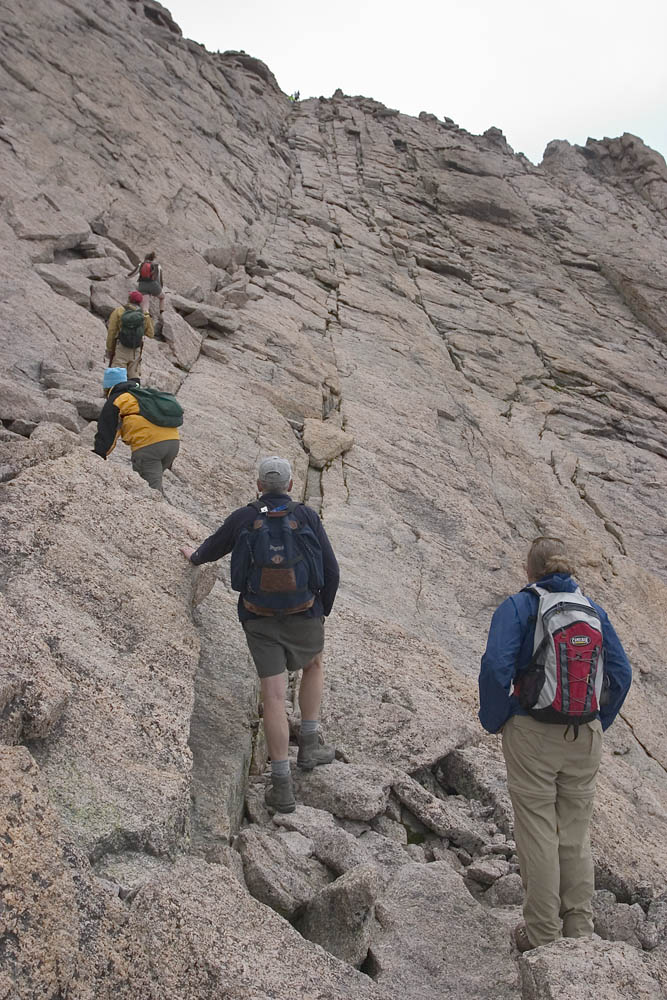
For my "A.W." contribution, I thought I'd share a bunch of pictures of Long's Peak. Instead of a long, wordy post about one picture, I thought I'd post a bunch of pictures and just a few words from a hike up to the top of Long's Peak a few years ago. Long's Peak has a special place in my heart in that Major John Wesley Powell was in the party that recorded the "first ascent" (undoubtedly the indigenous peoples had been climbing the mountains long before this).


The following year, I didn't climb the mountain, but rather hiked to the glacial tarn just below the peak (Chasm Lake). The long line of other hikers were winding their way around Mt. Lady Washington and continuing on to the summit. I turned off to the left and awaited the sunrise.


Wednesday, May 26, 2010

New equipment in the lab

My lab just got a new piece of equipment. Heh - it feels a little odd to say that after so many years of cobbling out space and time in other peoples labs, but I digress...

I just got a new stereo microscope with a boom stand (makes it easy to zoom onto irregularly shaped rocks and fossils) and camera attachment. I set it up today. Everything appears to be working, although I have to check to see if I've set up the camera attachment incorrectly, as there was more spherical aberration than I was expecting.

Here are some of the test images:


Pretty good magnification at 45x (I plan on looking into higher magnification for some samples in the future)


A tiny shell of Vertigo sp., possibly V. cristata I didn't get a look at the aperture or lamellae in detail. But the size shape and color appear to match this species.


And an homage of sorts to Ron Schott's sandy "geomeme" series: what is it?


And one more: what is it, where is it from?

Tuesday, May 25, 2010

Kelly McCullough book signing

Some of you may already know this, some of you may have no idea what's going on. But sci-fi/fantasy author Kelly McCullough (my friend who recorded this video of antidunes on the Hawaiian beach) is having a book launch today. The last in his WebMage series hits the shelves today, and he'll be at the Har Mar mall in the Twin Cities to sign copies. Greg Laden mentioned this as well. Some of you may recognize that mall as the annual home of the Minnesota Creation Science Fair (Greg Laden also makes a field trip to that fair about every year as well).

So, go buy the book. If you haven't read the series yet, buy all the books - they're out. They're snarky, funny, and have a cool mix of computer programming, magic, and greek mythology all rolled into one. I also can tell you with confidence that the last book doesn't disappoint. And if you're in the Twin Cities, stop by the Har Mar Mall tonight (May 25th @ 7pm). And tell Kelly that "Research at a Snail's Pace told you." Because both he and I will be greatly amused.

Tuesday, May 18, 2010

May 18, 1980


Today's post will be a short nod to the spectacular and devastating eruption at Mount Saint Helens 30 years ago this morning (8:32 AM PDT). It was a tremendous display of the earth's power and volcanic systems, surrounding communities faced millions of dollars in costs as a result of the eruption and its effects, and - sadly - 57 people lost their lives.

I took a field trip to the volcano last fall, and blogged about it several times.

The following images are more that I took on that trip. It was very wet, so I didn't get a chance to photograph the actual "breached dam overlook," but you can see part of the canyon in the photos.


You also might notice the odd use of depth of field. This is a result of using a Tilt/Shift lens to adjust the plane of focus. I'll devote more blog space to T/S lenses in the future, since their applications in geology are potentially valuable. But I show this image to make a point. That is of "advocacy." When we take a picture to illustrate a geologic phenomenon, we are using a tool (the camera/lens/film-or-sensor/light) to convey information. What we choose to exclude is as important as what we include. By throwing much of the area out of focus, I have "tricked" your eyes/brain into thinking the object photographed is much smaller than it really is. In a way, this is exactly what YEC's do when they try to make the case for biblical literacy for a young earth.

In their view, all things that happen point to "God's Word (TM)" and every piece of information will testify to the veracity of the bible. They will take single facts, such as the comparatively rapid formation of the erosional canyon on the pumice plain of MSH as direct evidence that the Grand Canyon was carved into sediment over a short period of weeks. If someone points out the obvious fact that sandstone, shale, and limestone they quickly turn their argument to the speculation that the sediments of the Grand Canyon were not rock at that time. If pointed out that precipitation of that much carbonate rock in a short amount of time would generate too much heat, they twist and turn and pull out some convoluted excuse about "thermodynamics." And their blurred misuse (abuse is more like it) of the laws of physics and math may get lost (or accepted by understanding nods and winks among other YEC-pseudoscientists). But they are deliberately blurring the picture. They are not acknowledging the whole. They are twisting and abusing individual facts to fit a completely non-functional model of the earth. It is disingenuous fraud perpetrated by those who have abandoned 400 years of observation and interpretation in favor of an older system of belief.


Don't let your pre-conceptions and expectations trump observation. Once you start forcing facts to fit "theory" you are not doing science. At best you are simply making a mistake. At worst, you are lying.

Friday, May 14, 2010

More Magnetic Dust, and an internet offer from "ASPEX"

So phase one is compete on my magnetic dust collection. I set out several versions of the magnetic collectors during the recent prolonged rainfall. I have not yet processed much of the material, but the majority of the magnetic dust appears to be small grains of micaceous minerals: phlogopite, muscovite, biotite - perhaps even vermiculite, plus some iron oxide particles from the shingles themselves.

Nothing clearly extraterrestrial, but the scope that I was using wasn't reaching very high magnification, so I won't be able to tell very much until I get a closer look.

Here are the other patterns of magnets that I tested:


For those of you at home, you can do the same thing. You can find a few links to micrometeorite sampling from the downspout on the interwebs (such as the one linked in the previous episode). I have a few additional suggestions, plus a company that specializes in scanning electron microscopy (SEM) sent me an email relating to one of their promotions.

First off, many sites describe using one large, powerful magnet. This works well, but if you think of the amount of time needed to "sort through" all that water or sediment, an array of smaller magnets will provide much more magnetic surface area to work with. I haven't noticed any loss of "attraction" with the less intense magnetic field of the array as compared to one big magnet. But it does make going through lots of material much easier. Plus, you can stick the magnets to a small sheet of galvanized steel flashing and fit it into the gutter directly. I tried two tests. For most of the arrays, I wrapped the magnets in a plastic Ziploc bag (turned inside out). Small rolls of tape helped hold the bag against the magnets - less air space between the plastic and the roof runoff allows more dust to be attracted to the magnet as opposed to washing away. Then I placed the magnet array/bag setup into the downspout gutter with the open end of the bag facing downhill (so it wouldn't fill with water). When I collected the bag, I just reached in and grabbed the magnet array and pulled the bag right-side in: this trapped the dust and remaining water inside the bag. I'll wash the bags into a clear glass or plastic tray for magnetic processing later.

On one magnet array, I simply wrapped a piece of clear packing tape across the surface (sticky-side down), covering the magnets. I took the whole thing inside and once it had dried, I placed another piece of packing tape onto the dusty surface of the array and smoothed it down. Lifting the tape back up, revealed the magnetic dust stuck to the adhesive. I placed this tape on a sheet of white paper (to see the dust, and to keep new dust from sticking to the tape). I'll use isopropyl alcohol to dissolve the tape adhesive and wash the dust into a collection tray.

Here's a closeup of the dusty tape, stuck to the paper:


The enthusiastic folks at "ASPEX" corporation have an ongoing promotion: "Send in Your Sample," to encourage people to send in samples of materials to observe under a Scanning Electron Microscope (SEM). There's even a YouTube video describing some of the methods they suggest. If you don't have access to an SEM, you might want to check it out. There are other good images of various household items viewed at high magnification as well. They state that the turnaround time is a few weeks, but I've heard some reports that the wait can be longer. It might have to do with the volume of material they have to get through, or it might be the difficulty in processing a particular sample. I asked them about using sticky tape to collect material and they said that should work well. Just be sure to tell them you want the stuff stuck to the tape analyzed. Plus, a piece of sticky tape attached to an index card or sheet of paper easily fits in the mail (as opposed to your cat or something).

Just to be clear, I have no affiliation with ASPEX - I'm not planning on sending them any materials since I have access to an SEM here at my University. Although their scanning electron microscope products do appear interesting and I may enquire into the costs of a unit for our department. I understand I'm giving them some "free" advertising and brand-name recognition for the company (their insistence on my using "scanning electron microscope" to describe their product suggests they want specific recognition for that search term). There is also a chance to have more people see the world of the very small. Since it's free, and I haven't heard of anyone being pressured to buy their own machine, I think it's a fine idea.

I'll try to follow-up with some of my own rooftop results soon. It's finals week here at school, so I've got some grading to do.