Well, The Other 95% and Snail's Tales among others are doing the "8 Random Things" meme. While I have not been posting often enough to warrant tagging others, I figure it'll give anyone stopping by something to chew on while I cook my data in a statistical stew and prepare to share it with the world...
1). I have loved dinosaurs since about age 3. I can say that I have discovered dinosaur bones, and dug them up. When I was in preschool, I drew a picture where I wrote, "I want to be a scientist or a bus driver."
2). I hate driving; I will not be a bus driver.
3). I have painted a full-size cast of a T. rex skull. It took me an entire day to finish.
4). I am extremely accident prone.
5). I prefer dry-erase boards to chalk boards to the point where I put a dry-erase board over the chalkboard in my office.
6). I have two noticeable scars on my head. The first came from running into a chain-link fence (I was running with my eyes closed, by the way) and the second was from sliding headfirst into a door jamb (at about the same age - go figure).
7). I am 6 years older than my sister.
8). I have counted more than 10,000 individual snails and sieved through more than 200 kilograms of mud for my dissertation.
Tuesday, July 10, 2007


Wednesday, June 06, 2007
What on earth has Pascal been doing?!?
It's been nearly four months since my last post. See what teaching a college course on dinosaurs as well as dissertation research will get you? A whole lot of "time for nothing else." Here's a shot of me in the field - digging for snails:

I've gotten a few comments that deserve a response, especially as it relates to the Driftless Area. But I'm off to Ohio to meet up with some geologists for a few days. I'll try to update sooner, rather than later.

I've gotten a few comments that deserve a response, especially as it relates to the Driftless Area. But I'm off to Ohio to meet up with some geologists for a few days. I'll try to update sooner, rather than later.
Friday, September 22, 2006
Where have all the snails gone?
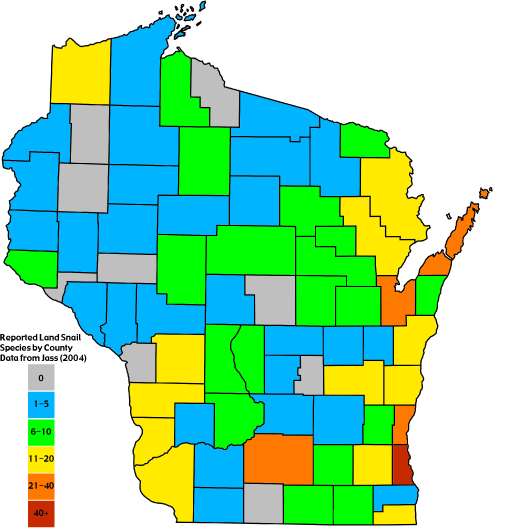
The above map I put together based on the summary paper by Jass (2004). In this paper, she echoes the call of Hubricht (1985) and others that much of the upper midwest is woefully undersurveyed for snail abundance. Notice the large number of Wisconsin counties with fewer than five land snail species reported for that county. The most populous counties (Dane, Milwaukee, Brown), those with state universities within them, have the highest abundance. This is definitely not a result of natural distribution - I've found snails in counties that have no official records. It likely reflects the fact that the researchers concentrated their efforts close to home. What does this mean? If we want to know the true extent of the distribution of snails on this continent, we need more people looking for snails. They are an excellent indicator species and have a great deal to tell us about the modern (and ancient) environment if we'd only stop to listen.
Thursday, September 14, 2006
Science and Reason: Philosophia Naturalis #1
Science and Reason: Philosophia Naturalis #1
Sorry for any repeat links - I'm trying out a remote linking option on blogger. But hey, this is the first carnival for this one, so it deserves two links :)
Sorry for any repeat links - I'm trying out a remote linking option on blogger. But hey, this is the first carnival for this one, so it deserves two links :)
Carnival Hat Trick
In short order, I have three posts at three different carnivals - including a brand new carnival, sure to please all you physical science types.
A travel bingo edition complete with drawings by the host. Very cool - and check out the rest of his site - very talented artists over there.
A fellow north-woodser gathers a slew of fascinating posts about birds. Who knew that there was another naturalist blogger in this area. How cool is that?
Science and reason has something for all you chemists, physicists, and non-biological earth science types. Check it out - and you geo-bloggers better step up to the plate!
Whew! I'm spent. See you for the next round in a couple weeks...
The first is over at The Tangled Bank #62:
A travel bingo edition complete with drawings by the host. Very cool - and check out the rest of his site - very talented artists over there.
Next up is I and the Bird #32:
A fellow north-woodser gathers a slew of fascinating posts about birds. Who knew that there was another naturalist blogger in this area. How cool is that?
Finally, the brand new science carnival, Philosophia Naturalis #1:
Science and reason has something for all you chemists, physicists, and non-biological earth science types. Check it out - and you geo-bloggers better step up to the plate!
Whew! I'm spent. See you for the next round in a couple weeks...
Tuesday, September 12, 2006
The Driftless Area, pt. 2
How did the Driftless Area form?
In the previous post, I talked about the what and where of the Driftless Area. This is a brief discussion on how. During the last Ice Age, the thick sheets of ice that covered much of the northern part of the US and nearly all of Canada went around the Driftless Area. How did that happen? There are a couple of primary thoughts regarding this. The first and most likely is a result of the highlands of northern Wisconsin and the Upper Peninsula of Michigan (UP). The second is slightly more complex and factors in the amount of liquid water at the base of a glacier. Liquid water? At the base of a glacier? Yup - and I'll mention why later in this post.
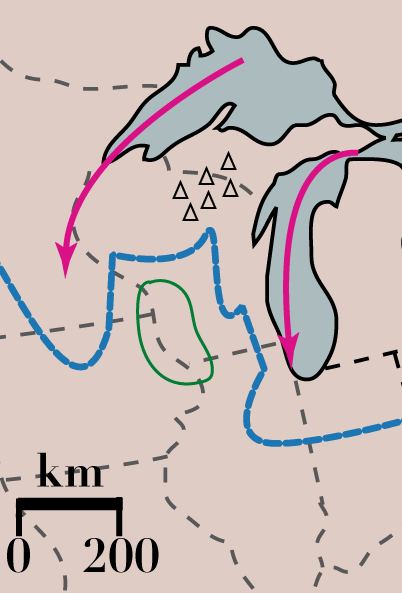
The most cited explanation (e.g. Syverson and Colgan, 2004) for why the glaciers bypassed the Driftless Area is because the area in northern Wisconsin and the UP is topographically higher (even pre-glacier) than the surrounding region (see figure on the right). This diverted the glaciers around them, and slowed its movement enough to prevent the ice from covering the Driftless Area (green circle). A subset of this idea is that while lakes Superior (upper left) and Michigan (lower right) were not as they are today, they were likely topographic depressions that would have acted as channels that encouraged ice to flow through them, bypassing the area inbetween. These hypotheses are quite robust - they explain how the Driftless Area avoided being covered by ice, and are backed up by a great deal of geological evidence such as glacial deposits, glacial striations on bedrock, and computer modeling.
Another possibility is that the porosity of the bedrock in the Driftless Area absorbed the liquid water at the base of the glacier, and prevented it from flowing into the region, "gluing" the ice to the ground. So how does water get to the base of a glacier? One is that this far south, there was a considerable amount of melting going on, even in the winter (it is warmer down here than it is way up north, after all). This water flows down through the ice and often finds its way into (or creates its own) channels along the base of the glacier. Another way is through pressure. With increased pressure, the temperature required to melt ice decreases. At the base of the glacier the pressure is sufficiently high enough, and it is not cold enough, so that water can exist. This film of water acts much like the film of water beneath a pair of ice skates - reduces friction and allows the ice to flow faster. No water, no flow (or very, very little). Hence, the Driftless Area, with its porous bedrock allowed water to get away from the glacier, and prevented the ice from moving.
This film of water is also what alows modern glaciers to surge, sometimes a hundred meters or more in a day. The water reduces friction so quickly that the ice just shoots down the valley. With increasing global temperatures, the chances of more glaciers surging increases. Without increased input of snow and ice near the head of the glacier, it could disappear all the more quickly. Granted, this is a simplified prediction of a complex process, but in basic terms, it's one of the concerns glaciologists have as the earth's temperature continues to rise.
Subscribe to:
Posts (Atom)