It's groundwater awareness week!
World in a Drop from Matt Kuchta on Vimeo.
Tuesday, March 12, 2013


Sunday, March 10, 2013
Digitizing the Em2
Some of you may be familiar with the Raspberry Pi minicomputer concept. Some of you might also be familiar with the Arduino digital interface/controller. My colleague Todd ordered a Raspberry Pi and it arrived this last week. I couldn't help but imagining how we could incorporate this tiny little computer into our Em2 hacks.
The Raspberry Pi has a few advantages over the Arduino board that makes the Pi a better base platform for digitizing the Em2.
Linux-based operating system, programming opportunities with Python
HDMI output for display on a large monitor
USB input/output for keyboard, mouse, hard drives, Kinect scanner, etc.
Ethernet (10/100) connectivity
SD card as boot/flash drive (download/mount data and images with regular computer)
General purpose Input/Output pins for connecting other devices
That last item - the I/O pins provide opportunities to connect to digital devices like the LRRD's digital flow controller, or other sensors that could collect data and then combine and sync all the output.
My first priority is to get the Raspberry Pi to talk to the Kinect and automate the 3D scanning process. Ideally, we'd have two Kinects to cover the entire stream table. These would then be linked to an overall timeline of a particular experiment run (with information on discharge, sediment supply, and base level). There is a digital camera in development (5 MP) that could form the basis of photogrammetry measurements. Being automated, one could lock the cameras into position to maintain consistency.
My dream setup includes a Raspberry Pi (or two) controlling:
•Discharge from digital flow controller (or monitoring via simple Ventury tube, pump voltage, etc)
•Kinect/3D data
•Sediment Supply system voltage (either the LEGO version I've got, or something more robust)
•Base Level elevation measurements
•Time lapse photography
•Optical sediment sensor consisting of a UV LED to record the presence of individual fluorescent plastic bits that make up a small fraction of the sediment (as an estimate of bedload transport)
•All synchronized to a single timeline
So, I'll keep on hacking and we'll see where we're at in a month, semester, or year, etc. Who knows - these kinds of things always end up changing as new opportunities arise, plans end up being overly ambitious, technology doesn't cooperate, or whatever. The thing to keep in mind is that (to rephrase John Lennon) "Research is what happens while you are busy making other plans."
The Raspberry Pi has a few advantages over the Arduino board that makes the Pi a better base platform for digitizing the Em2.
That last item - the I/O pins provide opportunities to connect to digital devices like the LRRD's digital flow controller, or other sensors that could collect data and then combine and sync all the output.
My first priority is to get the Raspberry Pi to talk to the Kinect and automate the 3D scanning process. Ideally, we'd have two Kinects to cover the entire stream table. These would then be linked to an overall timeline of a particular experiment run (with information on discharge, sediment supply, and base level). There is a digital camera in development (5 MP) that could form the basis of photogrammetry measurements. Being automated, one could lock the cameras into position to maintain consistency.
My dream setup includes a Raspberry Pi (or two) controlling:
•Discharge from digital flow controller (or monitoring via simple Ventury tube, pump voltage, etc)
•Kinect/3D data
•Sediment Supply system voltage (either the LEGO version I've got, or something more robust)
•Base Level elevation measurements
•Time lapse photography
•Optical sediment sensor consisting of a UV LED to record the presence of individual fluorescent plastic bits that make up a small fraction of the sediment (as an estimate of bedload transport)
•All synchronized to a single timeline
So, I'll keep on hacking and we'll see where we're at in a month, semester, or year, etc. Who knows - these kinds of things always end up changing as new opportunities arise, plans end up being overly ambitious, technology doesn't cooperate, or whatever. The thing to keep in mind is that (to rephrase John Lennon) "Research is what happens while you are busy making other plans."
Saturday, March 09, 2013
Emriver color-coded sediment, un-mixing the media.
My soil mechanics students had their grain size analysis lab this week. It's fun - they get to analyze granular materials by playing with sand. Specifically, the plastic sand that comes standard with the Em2 stream table. Last year I ran the standard media through a stack of sieves. This year, I ran the color-coded plastic media through the sieves.

These gradation curves are a quick way of describing and comparing different sediments. The standard media (blue curve) is different by having a little bit less material between 2 and 1mm in size (but more material larger than 2.4mm), and quite a bit more fine material around 0.5mm. The horizontal axis is in microns (1 mm = 1,000 microns) and it's on a log scale, because there's such a huge range in diameter.

Here's a frequency curve showing the relative proportions of various size fractions. The "Phi Value" is another way sedimentologists scale the wide range of particles (Phi Value = -log2diameter in mm). So the Phi Value of a sand grain 1 mm in diameter is zero. Notice the big bump in the standard media between 1.5 and 2 phi. My own speculation is that as the material moves around, the big particles grind themselves down into particles around this size (0.3mm).
What you can't see, and what is the true brilliance behind the color-coded material, is how moving water separates the color-coded particles into various color patterns. You can also see the colors in the sieve separates, too.
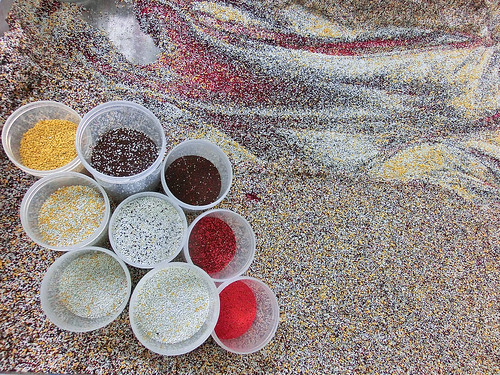
So let's look at the distribution of grain sizes in the color coded media a little more closely:


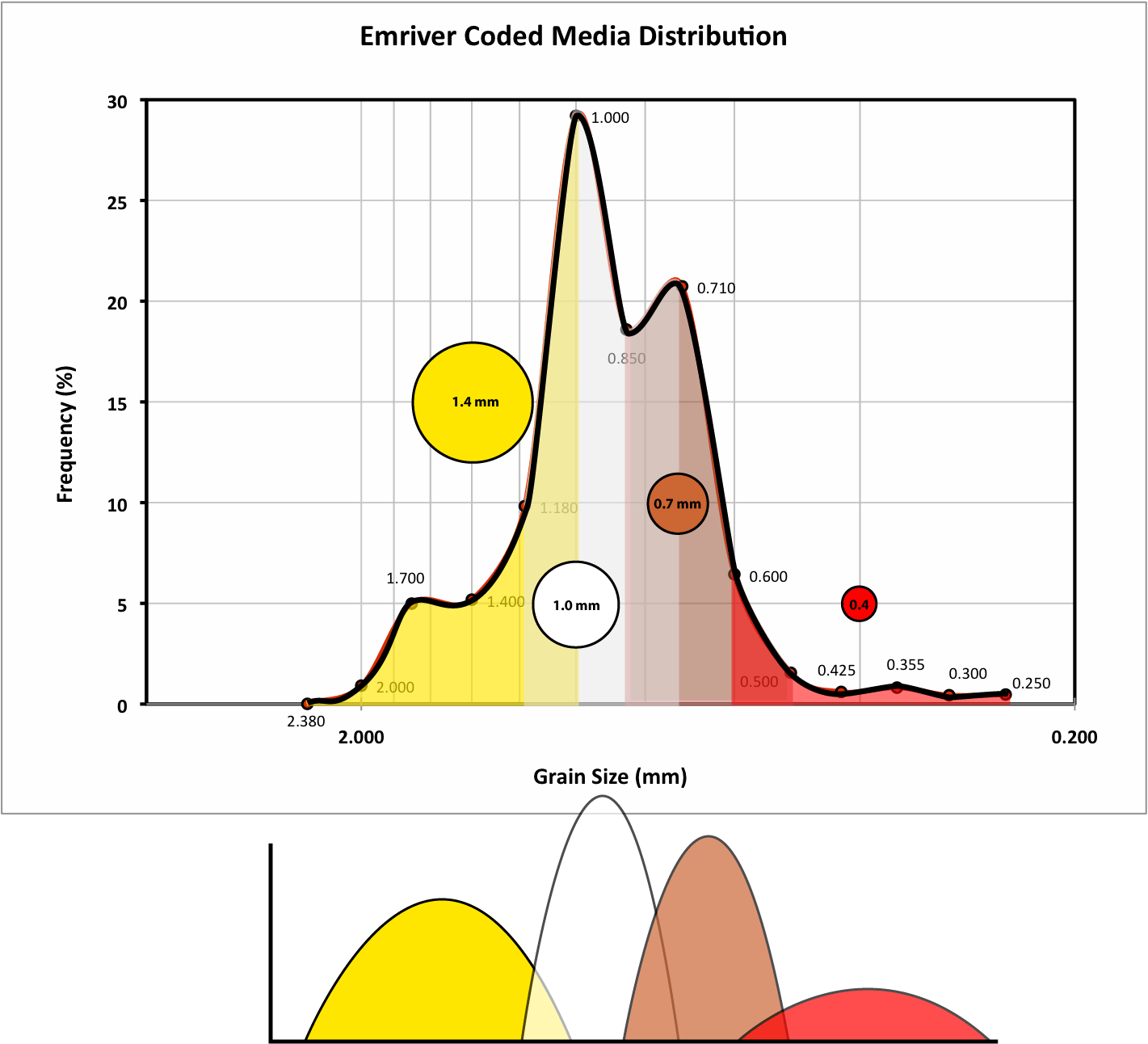
Here's an overlay of the color fractions - the curves below represent approximate distributions of each individual fraction.

Here's a picture from Steve, the big guy at LRRD's blog (Riparian Rap), showing the Em4 being filled with unmixed coded media. Given that some of the smallest yellow particles are smaller than the largest white particles, un-mixing the coded media into perfect color fractions isn't possible by mechanical means alone.
My plan now: use the grain size distributions to create "color facies" for the plastic media - providing a way to do grain size analysis with time lapse photographs.
Update: talking with Steve over email, I realized that the color fraction "curves" as drawn above may imply more quantitative "knowledge" than I really have about the distribution of each color. Here's a histogram, with the color fractions approximated by visually estimating the proportion of different colors visible in each container (vertical scale is in grams):

Thursday, March 07, 2013
Slow-Mo Sedimentation: When Stokes' Law Doesn't Apply
Thanks to the ever helpful folks at LRRD, the colored sediment for my lab's Em2 arrived last week. I shot some high speed video of a scoop falling through water. Based on the results, I tried again with the help of my colleague Todd Zimmerman. We tried a few different colored gels on the translucent backdrop, but the first one that I used, a nice deep blue, works the best. I think it's because of the red-orange hues in all of the sediment particle sizes contrast well with the blue.
Colored sediment: when Stokes Law does not apply from Matt Kuchta on Vimeo.
Contrast this video with the footage we captured a few years ago of ball bearings falling through corn syrup:
What a Drag! Falling Through Syrup from Matt Kuchta on Vimeo.
The single ball bearing is a good example of how Stokes' Law works. I blogged about it before, too. But the first video shows many particles. These particles are banging into each other, the combined mass of the particles is also pushing the water around in turbulent eddies. Stokes' Law does not apply because the settling of each particle is hindered by interactions with other particles and the surrounding fluid. In these cases, we're often without a simple, elegant equation to describe what's happening. Instead, we have to rely on empirical observations. Such as the bedforms left behind in the sediments after the particles are deposited. In the end, however, many of the smallest particles are left behind to drape over the entire pile of material. So even in these chaotic, turbulent systems, Stokes' observations can still help inform us of these processes.
Colored sediment: when Stokes Law does not apply from Matt Kuchta on Vimeo.
Contrast this video with the footage we captured a few years ago of ball bearings falling through corn syrup:
What a Drag! Falling Through Syrup from Matt Kuchta on Vimeo.
The single ball bearing is a good example of how Stokes' Law works. I blogged about it before, too. But the first video shows many particles. These particles are banging into each other, the combined mass of the particles is also pushing the water around in turbulent eddies. Stokes' Law does not apply because the settling of each particle is hindered by interactions with other particles and the surrounding fluid. In these cases, we're often without a simple, elegant equation to describe what's happening. Instead, we have to rely on empirical observations. Such as the bedforms left behind in the sediments after the particles are deposited. In the end, however, many of the smallest particles are left behind to drape over the entire pile of material. So even in these chaotic, turbulent systems, Stokes' observations can still help inform us of these processes.
Tuesday, March 05, 2013
Emriver Color-Coded sediment in action
A little test run with the new color-coded sediment that arrived last week. It's so pretty!

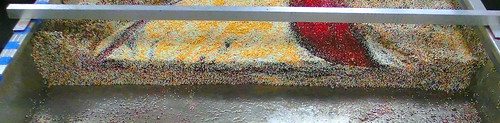
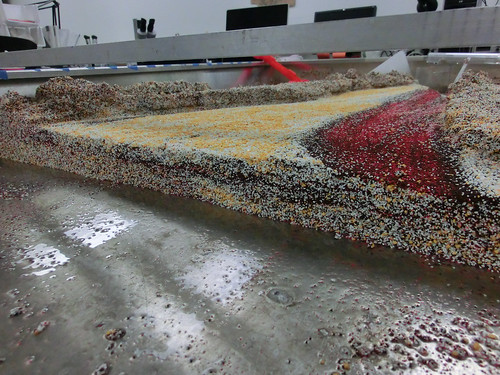
I seem to recall some fluvial stratigraphy diagrams tossing around facies patterns that look strikingly similar.
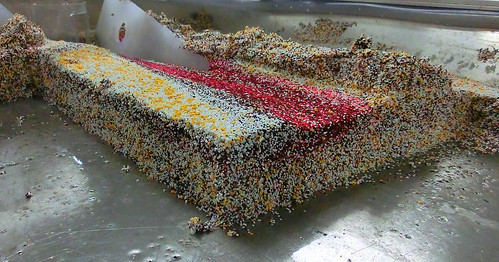
I'm rather excited about 3D facies mapping possibilities here. Too bad I have so many other irons in the fire.
Saturday, March 02, 2013
Sediment Transport Porn
I think I've found the right material to use in high-speed video of sediment transport.
A link for aggregate readers that may cut things off: https://vimeo.com/60882601
The color-coded media supplied by Little River Research and Design looks absolutely gorgeous. I got some the other day and I just had to grab a few scoops to shoot some video friday afternoon:
Color-Coded Sediment from Matt Kuchta on Vimeo.
Some new material arrived in the lab today. Just a quick clip of a scoop of the color-coded sediment settling onto the bottom of a glass of water.
A link for aggregate readers that may cut things off: https://vimeo.com/60882601
The color-coded media supplied by Little River Research and Design looks absolutely gorgeous. I got some the other day and I just had to grab a few scoops to shoot some video friday afternoon:
Color-Coded Sediment from Matt Kuchta on Vimeo.
Some new material arrived in the lab today. Just a quick clip of a scoop of the color-coded sediment settling onto the bottom of a glass of water.
Subscribe to:
Comments (Atom)