Showing posts with label projects. Show all posts

Thursday, February 06, 2014

A Get Well TARDIS for Caitlin

Get well cards are cool.

Our friends Michael and Lynn Thomas have a wonderful daughter. Caitlin had surgery recently and it's been a long challenging week for all of them (nine days, actually). I had been kicking around the idea of a get well card that also served as some geek sculpture/puzzle to send to them. It's a chance for me to try crafting something new and it'll give Lynne and Michael something to work on while they're at home with Cait

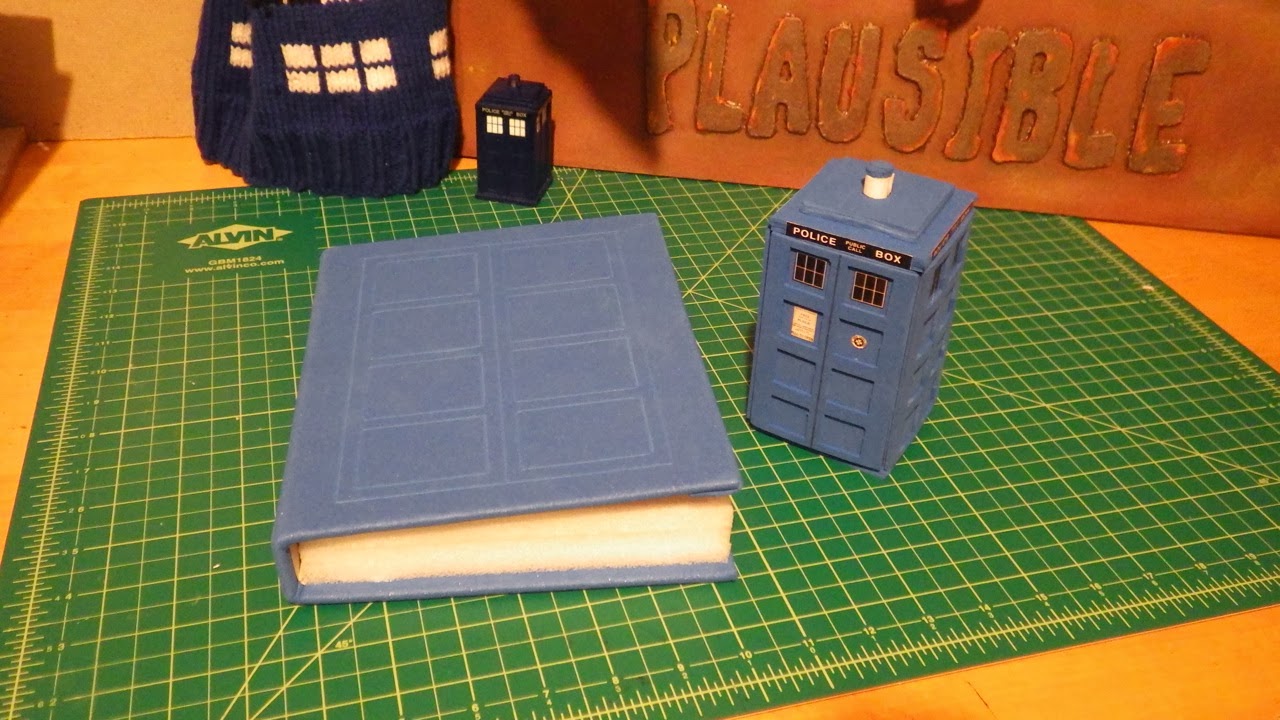
A blue book. I used a small stylus to emboss the pattern in the front cover.

With various parts. The book is just a few pieces of cardboard, covered in blue craft foam. Another kind of project foam for the "pages" and then shapes cut out of it to hold the TARDIS parts.


Some more parts.


All of the parts removed from the book.

The rolled up note is the center column, the yellow "console" fits around the note.

Most of the TARDIS was cut out of blue craft foam with printed lettering glued on.

The top and bottom fit into the middle.


It's possible there's a wee bit of geekery in this picture.


Wednesday, September 15, 2010

Continuing Thots on the Geoblogosphere

So things are getting underway here at RaaSP central. A new semester brings with it new students, new projects, and new responsibilities. I have been hired as an Assistant Professor at a State University for a tenure-track position teaching earth-sciencey type classes. There is no geology department (I'm it), so I'm stuck with a bunch of physics professors. This is not nearly as dire as it sounds. They're a great bunch of professionals who enjoy teaching as much as research - a good fit for my interests. My wife also works at the same school, so that's also important.

Being an assistant prof requires a whole new slate of obligations. That's also fine, since many of these obligations have me interacting with interesting people who are doing interesting things. It doesn't leave me as much "free" time as I would need to have a "SOOPER BLOG!1!" That's also fine, because I like my job, and I want to stick with it. But trying to associate myself with some of the bigger names and networks of the geoblogosphere might require too much of my attention. The best blogs have near-daily content. I am lucky to have one or two days in a week where I can put something thotful together. That is also fine, because there are many good blogs out there that talk about interesting things.

But there aren't many blogs that talk about all of the things that are interesting to me. There aren't that many blogs that parse information in a way that I would prefer, or with the detail I want. So I will be content in my role as one of these lesser blogs that tosses something into the ether on a somewhat less than regular basis.

I will also be increasing my presence on our University's web presence by placing research/teaching/outreach materials there. I will be continuing my original mission of geo/snail info on this blog and linking to my other "interesting stuff." I'm also removing some of the veil of anonymity that has been this blog's MO for the past five years. I figure that one important leg in a professor's tenure track is outreach, so there will be lots of reaching out. But more so as the voice of a professional and educator, as opposed to some mysterious 17th century mathematician cum programming-language slash unit-of-pressure.

Everything I plan on doing has one primary purpose: my tenure. To get there, I will use teh blog/internets as one arm of my outreach. But as a "professional" academic, there are a few cautions to maintain:

  • Professional Affiliations:
  • I do not, nor will I represent anything but my own personal take and opinions on this blog. It will in no way be meant to represent the positions or opinions of my Department or University. As such, I will probably have to avoid some issues related to academia, while focusing more attention on others.


  • Proprietary Information:
  • Some things that I really want to share with people may have to wait - some things may represent ongoing research that will be published later. Other things may be withheld due to grant funding (I can't very well tell you where to find endangered snails if some of the money that paid for my work came from the NHI). But there are also some ongoing research projects that I will make available as they happen. The mating snail behavior, for example. Blogging is a great way to share "what's new right now." Some of this work may be part of a student project - to keep things fair to the students doing the work, I'll describe active research projects in a way that allows for the students to contribute their thoughts.


  • Copyright:
  • As a result of integrating my employment, some "things" have slightly more complex copyright issues (see also "Proprietary Info"). My "work" done for this blog may have a few extra notes about how the material should be re-used. The Creative Commons has a good system that I will utilize whenever possible.

    I'm sure there are other things that I'll think of that can/will change. For now, this site will provide a link to my University page and professional information. Other things probably don't require any kind of formal description. But, being the web, I'll probably write about some of it - it's somehow satisfying seeing one's thoughts in "print."


My Faculty Page.

My Department.

My University.

Thursday, April 29, 2010

Pinhole Camera

Okay, so it's not like I don't have enough random interests. But teaching in a physics department provides a diverse instructional load. One day I'm teaching about rivers and streams and the next day I'm teaching about the resistivity of Nichrome wire. The 2nd semester physics class is starting to talk about light. One of the biggest everyday experiences people have with light (aside from it being "day" and there being sunlight by which people can see...) is via cameras and lenses.

In order to understand some of the basics about lenses and optics, "pinholes" make a good start. Plus, it's easy enough to build a pinhole viewer (or "camera") from everyday items. The idea is to get the image projected from the pinhole to light up a "screen" and make the surroundings dark enough to see the resulting projected image.

The "cardboard tube pinhole camera" has many varieties. But I decided to try my hand at upscaling the project. Just like sedimentary particles, it's always fun to go big, so I made a bigger one that zooms in and out, changing the apparent magnification of the image:

Here's the completed Pinhole Zoom Viewer.


I was fortunate to have two thick cardboard poster tubes that nested inside each other, This made it easier to assemble. You could make nesting tubes by rolling tagboard or heavy paper, but there would be some additional work to smooth out the seams so that extra light won't leak in.


To start, gather the necessary materials: two nesting cardboard tubes (light-proof), a sheet of aluminum foil large enough to cover one end of the large tube, a sheet of wax paper (tracing paper might work too) to cover one end of the small tube, and some tape. You may also need scissors, extra black construction paper and stuff to "pimp out" your viewer.


Cover one end of the large tube with aluminum foil. Keep the foil taught (like a drum head) over the tube's opening. Tape it down so that no light can get in around the sides. Cover one end of the small tube with the wax paper - this is your projection screen. The "screen" end goes into the bigger tube. Make sure there's enough space to slide it in, but not so much that light can get in around the edges (sense a theme here?). Now take a narrow pin, or paper clip, and punch a narrow pinhole in the center of the foil. This pinhole should be somewhere between 0.5 and 1 mm in diameter (check the web for further discussion on the pinhole diameter - and discussion about making the foil more effective).

The reason for the long tube between your eye and the image "screen" is so that it's dark. You can fashion a "hood" around the viewport to block even more light with additional construction paper, as I did with my version. Although if you snug the tube up to your eye, you can probably get it to work okay.


Since the projected image is of a certain size, by extending the tube, you effectively "zoom" in on a small portion of that image, increasing the apparent magnification (this is part of the reason why "zoom" lenses on cameras do what they do). To take in a wider view, push the tube in. This typically works best outdoors in bright sunlight - although you can see the effect by looking at a light source (like a light bulb or candle) indoors.


Here's a quick test I did by placing my zoom viewer on top of a digital camera and lens (exposure time of a couple of seconds at ISO 800). You could try to place the pinhole viewer directly on the camera body (without lens), but if you're not familiar with how to keep the image sensor clean, you might want to hold off on that step. My next test images will probably be to set up the viewer on a tripod and take a picture of some objects outdoors (but the rain today and tomorrow will probably delay those plans).

Anyway, this project seems to work well for "kids" of any age. Even cynical college students get a kick out of seeing an image through these things. And it only takes a few minutes to build the simple ones.

UPDATE (10/12/2010): I have another post about turning your DSLR into a pinhole camera.

Thursday, November 15, 2007

Update

What has Pascal been doing? Here's a list:


  • Writing his dissertation outline, assembling necessary figures

  • Teaching sedimentology/stratigraphy

  • A little photography

  • Writing his dissertation chapters

  • Presented a poster at GSA last month based on Amino Acid results from Ice Age snails

  • Studying pterosaur flight and building gliding and rubber band-powered models of Rhamphorhynchus

  • Collecting modern snails from a small park near the University, including finding a live succineid, Succinea aff. ovalis, who should appear on this blog before long.


Each of these topics is fermenting in my head, and will hopefully appear on this blog soonish.