
Showing posts with label emriver. Show all posts
Showing posts with label emriver. Show all posts
Saturday, March 16, 2013
Using Photoshop for Stream Table Image Analysis
Yet another wonderful thing about the color-coded plastic media is the ability to analyze stream features over time. The colors tend to organize themselves into patterns based on where the water is flowing that correspond to areas of erosion, transport, and deposition. My hope is that I can use these colors to define active/abandoned channels in each time lapse frame - stacking frames will show how those channel patterns over time. But how to simplify the images? One of the challenges lies in the fact that the yellow sediment contains some red hues - a simple saturation boost would make the yellows pop out too much. So I grabbed a picture of the stream table and tried out some Photoshop filters and adjustments to simplify the image. I've put them into an animated gif to show the differences.

I've noticed that the smallest red grains tend to show up in areas of scouring, while the white and yellow are often the first to move and the first to be deposited. Some of these adjustments really help pull out the yellow and red. Now it's time to get a time-lapse sequence and try some time series analysis.


Even more grain data

I have also been analyzing the sieved fractions for specific gravity (SG). As mentioned before, I noticed the white material was yielding lower SG values than the other colors. Steve Gough suggested that I let the material soak a little longer. I had done that with a few samples, but I've started to let them soak overnight. The white material is still producing slightly lower values than the yellow, brown, or red. Here's a summary of the results so far (the two lowest SG values weren't soaked overnight):


Wednesday, March 13, 2013
Specific Gravity of coded media
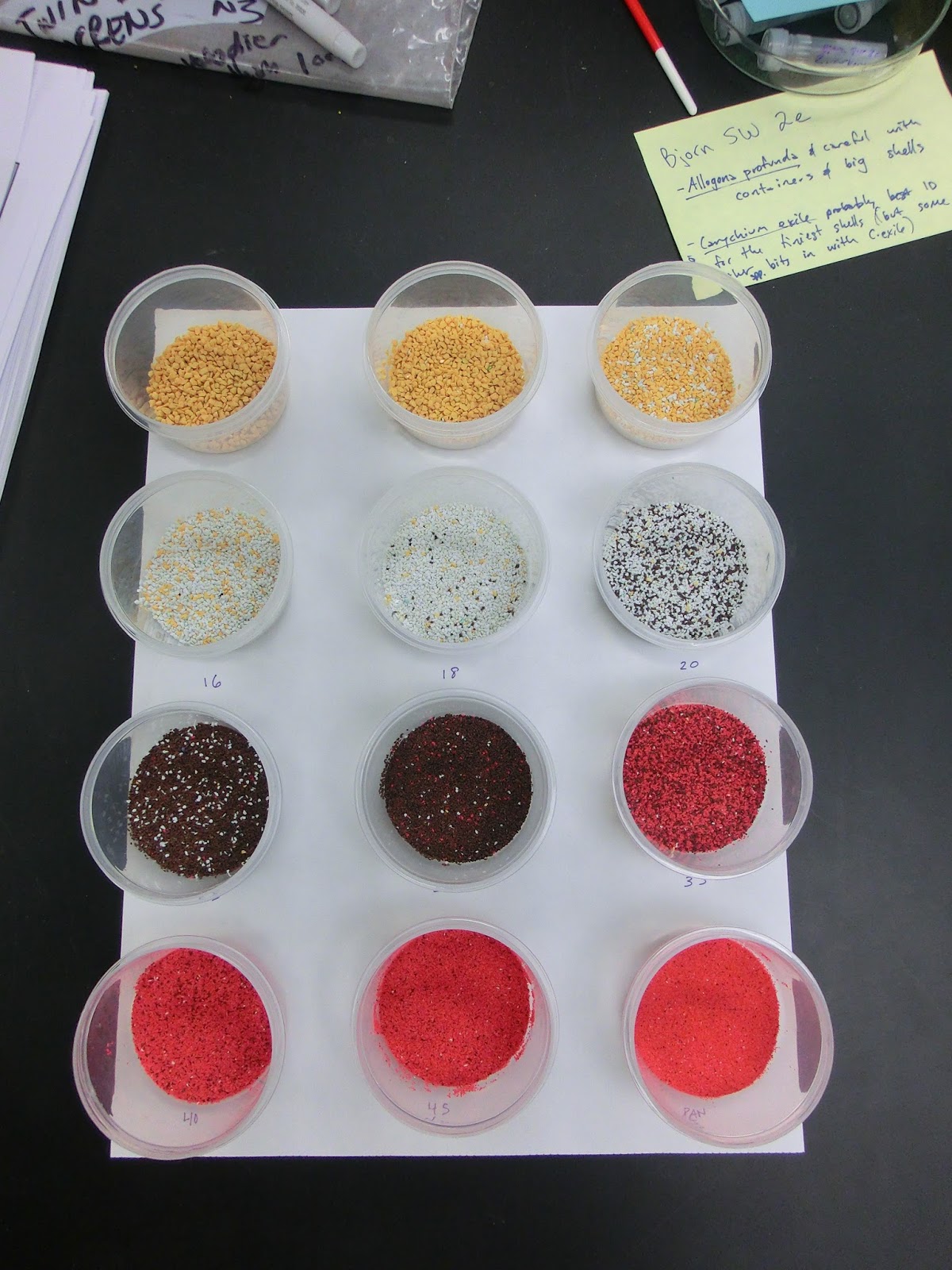
I've been measuring the specific gravity of the color-coded plastic media. The sieve fractions that I separated earlier yielded some interesting preliminary results:
 These represent single measurements - so there may be a lot of variation that's not accounted for. I used a volumetric flask and vacuum method to remove the air bubbles. The white fraction did appear to generate more bubbles than the other color fractions, so perhaps there is something inherent in the material to explain why they seem to have a slightly lower specific gravity. Does this influence how the material sorts itself during a stream run? Maybe, but there's lots of other fluid dynamics stuff to consider, too.
Here's one of Steve's Time-Lapse videos showing how running water can generate gorgeous color patterns.
Steve Gough posted a comment, but it was eaten alive by Google:

Here's one of Steve's Time-Lapse videos showing how running water can generate gorgeous color patterns.
Steve Gough posted a comment, but it was eaten alive by Google:
This is super interesting to us at LRRD! We ran a lot of specific gravity tests as we developed the media; and found very close clustering, but more at about 1.60. I'm not too concerned about a 0.05 difference between colors, but if it got bigger I would be! Melamine has very low water absorption (for some plastics it can be 10% plus), but it's possible that's part of the problem; you might try soaking all the samples for a few days before testing. Thanks!
Sunday, October 16, 2011
Emriver setup
Before and after shots of the new stream table that arrived this week. If you look at the clock in the background, you can see that it only took me about an hour to set up. I'll have to provide more detail about setup and running the stream table.


Subscribe to:
Posts (Atom)