
Thursday, February 20, 2014
So. Much. Snow.
It's been a cold winter up here. And we're in the middle of a pretty impressive snowstorm, too.
I suspect we're going to lose a few branches in the back woods. Which will be good for improving the litter conditions of the woodland floor.


Friday, February 07, 2014
Dispatches from the Dirt Lab, 3rd Edition

It's been cold around here. Very cold. Cold enough that boiling hot water seems to instantly vanish into clouds of steam when thrown into the air. So I did. Just to be clear - do not throw large volumes of boiling water directly into the air over your head. The risk of scalding is real. I used heavy welding gloves to protect my hands and used a squirt bottle to turn the water into small droplets so that any water that would have landed on me would be a small, rapidly cooling droplet. I also aimed the stream of water away from my body.
Dispatches from the Dirt Lab #3: Tea Time and the Polar Vortex from Matt Kuchta on Vimeo.
Where I demonstrate what happens when really hot water meets really cold air.
Although it was only about -14°F (about -26 C), the effect is pretty obvious. Huge billowing clouds of steam. In slow motion it looks pretty freakin' awesome.
Thursday, February 06, 2014
A Get Well TARDIS for Caitlin

Get well cards are cool.
Our friends Michael and Lynn Thomas have a wonderful daughter. Caitlin had surgery recently and it's been a long challenging week for all of them (nine days, actually). I had been kicking around the idea of a get well card that also served as some geek sculpture/puzzle to send to them. It's a chance for me to try crafting something new and it'll give Lynne and Michael something to work on while they're at home with Cait

A blue book. I used a small stylus to emboss the pattern in the front cover.

With various parts. The book is just a few pieces of cardboard, covered in blue craft foam. Another kind of project foam for the "pages" and then shapes cut out of it to hold the TARDIS parts.

Some more parts.

All of the parts removed from the book.

The rolled up note is the center column, the yellow "console" fits around the note.

Most of the TARDIS was cut out of blue craft foam with printed lettering glued on.

The top and bottom fit into the middle.

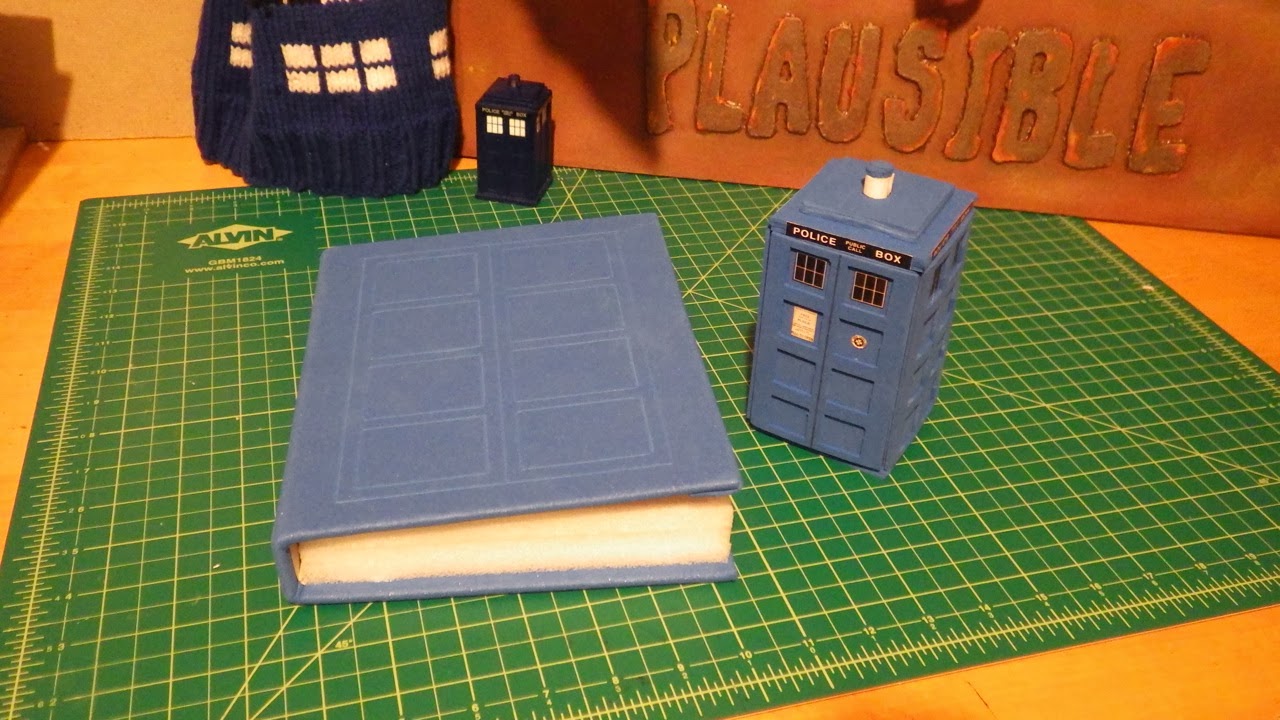
It's possible there's a wee bit of geekery in this picture.
Tuesday, January 14, 2014
Back from Vacation
My wife and I went on vacation last week and I'll be sharing pictures and stories soon. To give you a hint as to where we went and what we were up to:


Tuesday, December 31, 2013
2013 In Review: GSA in Denver
Okay, last up for the year in review (I'm not going through spring/summer things, because vacation).
In late October I journeyed out to Denver for the annual Geological Society of America meeting. This year I had some special projects planned. First, I brought along my Kinect scanner - and Steve Gough of Little River Research and Design was kind enough to let me set it up on one of their stream tables on display. Second, I brought our high speed camera to catch the Emflume in operation.


gx8 1917-Emflume9-sed-trans from Matt Kuchta on Vimeo.
gx8 1917-Emflume7-paddle from Matt Kuchta on Vimeo.
gx8 1917-Emflume10-paddle from Matt Kuchta on Vimeo.
In late October I journeyed out to Denver for the annual Geological Society of America meeting. This year I had some special projects planned. First, I brought along my Kinect scanner - and Steve Gough of Little River Research and Design was kind enough to let me set it up on one of their stream tables on display. Second, I brought our high speed camera to catch the Emflume in operation.

There was a Mythbusters exhibit at the DMNH while I was there (some might call this a running gag for the year)

A very Daffy-Duck looking hadrosaur.

Went on a photography field trip, got to give my tilt-shift lens a workout.

The camera and lighting of the flume.

Just like any good party, every flat surface is covered in empties and wounded soldiers.
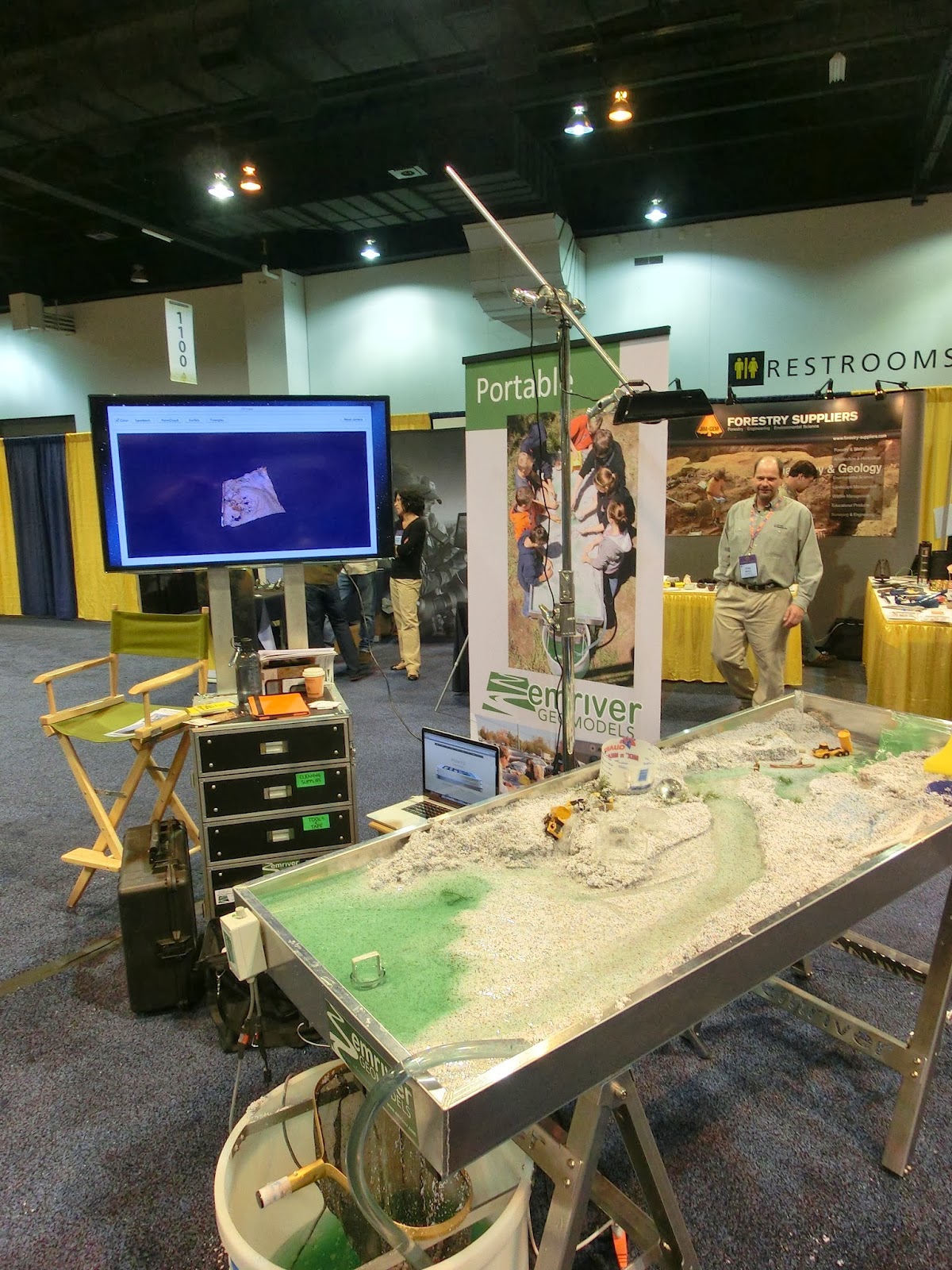
The Kinect scanner - mounted on a lighting stand and placed over the table. The computer is hooked up to the large monitor in the background so people could see the live 3D image.

This is what the stream table looked like after a day of visitors.

Steve hoping the day would go well. Or appealing to the powers of Arduino to get his time-lapse slider to work properly.

Ron Schott (fellow UW-Madison alum and one of the few students who were there longer than I was) was trying out his Google Glasses.

Which I got to try out. A little awkward when worn over regular spectacles, but I can see some potential uses for the technology for science outreach.
gx8 1917-Emflume9-sed-trans from Matt Kuchta on Vimeo.
gx8 1917-Emflume7-paddle from Matt Kuchta on Vimeo.
gx8 1917-Emflume10-paddle from Matt Kuchta on Vimeo.
Monday, December 30, 2013
2013 In Review: TED Ed
Another great thing this year was getting to go to New Orleans and talk to a bunch of Middle and High School students about science. I gave a 6 minute talk about "sand" and got to talk with a bunch of motivated students.
There's something special about those three red letters and the little orange mic that makes a person feel like they're giving a "real" talk.

I also gave students instructions on proper hand-lens technique. Remember folks, hold the lens to your eye and bring the object into focus.
My trip was made more interesting by the fact that I had one of the worst head colds in my life right before I left. I could barely talk and my head was so stuffy it sounded like I was talking to people inside a diving helmet that had been filled with jell-o. But I managed to get enough rest and got through my talk and survived the first intermission talking to students - my voice totally gave out during the second intermission - which was too bad. I wish I could have talked to more kids about geology. But the table next to me had enough cool whale parts to keep kids entertained far better than I could with a few rocks and bags of sand.


That's some Bass! from Matt Kuchta on Vimeo.
16-year-old DJ Cole Plante's presentation came with plenty of low frequency rhythm. Here's a water bottle sitting next to one of the balcony lights. The waves were generated by the bass line of Cole's music mix.
I had a blast - thanks to the TED team for making it fun for those presenting. I got to meet physics blogger Rhett Allain, share a cab ride from the airport with robot scientist James McLurkin, talk photography with Jonathan Mannion, and share a cab ride back to the airport with the head of Pixar's Research Group. There were several "kids" that gave talks, too - although "young adult" really is appropriate here. I can't imagine what it's like to be 14 years old and get national recognition for the transformative/innovative things they've already done (in some cases since they were eight).
There's something special about those three red letters and the little orange mic that makes a person feel like they're giving a "real" talk.

Obligatory selfie during rehearsals.
I'm glad my shoes matched my shirt - otherwise it would have looked like I was just this hawaiian-shirt clad torso.
Photo by Ryan Lash
Photo by Ryan Lash
I also gave students instructions on proper hand-lens technique. Remember folks, hold the lens to your eye and bring the object into focus.
Photo by Mike Femia

Anatomist Joy Reidenberg with her table of whale parts. Those are 8' long sheets of baleen (blue whale I think)

Homologous structures FTW!

Big crowd at the Civi Theater. Those screens on the balcony ledge were there so we could see our slides without turning our backs to the audience. The red light between them showed how much time was left.

Did I mention that Ashton Kutcher was the secret guest speaker?
That's some Bass! from Matt Kuchta on Vimeo.
16-year-old DJ Cole Plante's presentation came with plenty of low frequency rhythm. Here's a water bottle sitting next to one of the balcony lights. The waves were generated by the bass line of Cole's music mix.
I had a blast - thanks to the TED team for making it fun for those presenting. I got to meet physics blogger Rhett Allain, share a cab ride from the airport with robot scientist James McLurkin, talk photography with Jonathan Mannion, and share a cab ride back to the airport with the head of Pixar's Research Group. There were several "kids" that gave talks, too - although "young adult" really is appropriate here. I can't imagine what it's like to be 14 years old and get national recognition for the transformative/innovative things they've already done (in some cases since they were eight).
Subscribe to:
Posts (Atom)